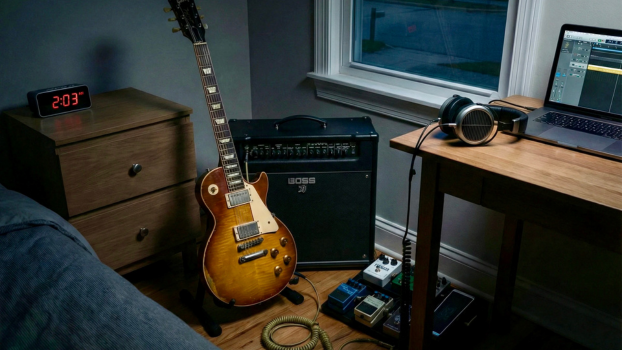
Back in 1984, there was only one rule for getting good tone: Turn it UP!
My first rig didn’t even “wake up” until the master volume was past 7. To get that Randy Rhoads sustain or that thick Hetfield chug, you had to push air and shake the walls.
That was fine at age 15 in a garage, but life looks a bit different as an adult. You might have a business to run, neighbors to respect, and maybe a baby sleeping upstairs.
In this article, I’ll show you the best quiet electric guitar setup to keep you playing and inspired.
After 41 years on the fretboard, I’ve realized the root of most practice failures isn’t a lack of talent, it’s a lack of compression. You don’t need volume to sound like a rockstar; you need gear that mimics the “feel” of a cranked amp. Run a compressor pedal after the tuner in your chain to even out your signal and to provide a consistent sustain.

So, what do most frustrated guitarists do? Well, you buy a nice amp, turn the volume knob down to 0.5, and wonder why your expensive gear sounds like a dying mosquito.
Here is the lie that kills practice habits: We think we miss the volume. We don’t.
What we actually miss is the compression and sustain.
When a big amp is cranked, the speakers push back. The sound compresses, making the guitar feel “liquid” under your fingers. Legato feels easy. Pinch harmonics scream with barely a touch.
When you turn that amp down to whisper levels, you lose that physics equation. The guitar feels like a windup toy and you have to fight the strings to get a note to ring out.
That friction is why you stop practicing. It’s not fun to play a guitar that fights you.
The good news? We’re living in the golden age of “Bedroom Tone.” Digital modeling and solid-state tech have finally figured out how to fake that “cranked amp” feel at volumes lower than a TV.
You might have just picked up a solid, budget-friendly rocker like the Epiphone Les Paul Studio E1. It’s a great guitar, but even a gem like that sounds thin and lifeless if your amp isn’t working with you at low volumes.
I’m going to show you the 3 specific rigs I use to get that “Master of Puppets” crunch at 2 AM without waking up the dead.
If you are an entrepreneur or a busy professional, your biggest enemy isn’t lack of talent, it’s friction. If it takes twenty minutes to setup your gear and dial in a tone, you’ve already lost half your practice window.
The Positive Grid Spark 2 is the ultimate “friction-killer.” It sits on your desk or end table, looks like a piece of high-end audio gear, and is ready to rock the second you hit the power switch.
In 1984, a “practice amp” was a box of bees. It sounded thin, rattled at low volumes, and had zero inspiration. The Spark 2 uses smart modeling to mimic the physics of a cranked tube head.
While the Spark 2 is the current king of the desk, it’s part of a massive surge in affordable, high-tech gear. If you’re looking for other options in this price range, check out my deep dive into the best portable guitar amps under $300.
| Feature | Why it matters to you |
| 50 Watts | Plenty of headroom for “feeling” the notes at low volume. |
| Onboard Looper | Builds the habit of playing in time; essential for rock rhythm. |
| Optional Battery | You can move from the office to the porch without a power cable. |
| Smart App | Thousands of tones at your fingertips (no more knob-fiddling). |

The Honest Truth (Cons): While the looper is built-in, you really need the Spark Control X foot pedal to use it effectively.
Trying to time a loop with your finger while holding a guitar is a recipe for frustration. Also, the app is great, but it requires you to have your phone or iPad nearby to get the most out of it.
The Spark 2 works because it provides immediate validation. When you plug in and instantly sound like your heroes, your brain treats practice as a “win” rather than a “chore.” This is how you turn a fleeting interest into a lifelong character trait.
The Spark 2 is a fantastic way to keep your momentum going, much like using a structured app. If you’re looking for a guided way to practice with this rig, check out my Simply Guitar App Review to see how it pairs with modern gear.
Sometimes, even the best desktop amp at low volume is too much. If your spouse is a light sleeper or your apartment walls are paper-thin, you need a solution that produces zero external noise.
The “root problem” with traditional headphone practice is the mess of wires.
In the past, you needed an amp, a long headphone cable, and a guitar cable, a tangled nightmare that makes you not want to pick up the guitar.
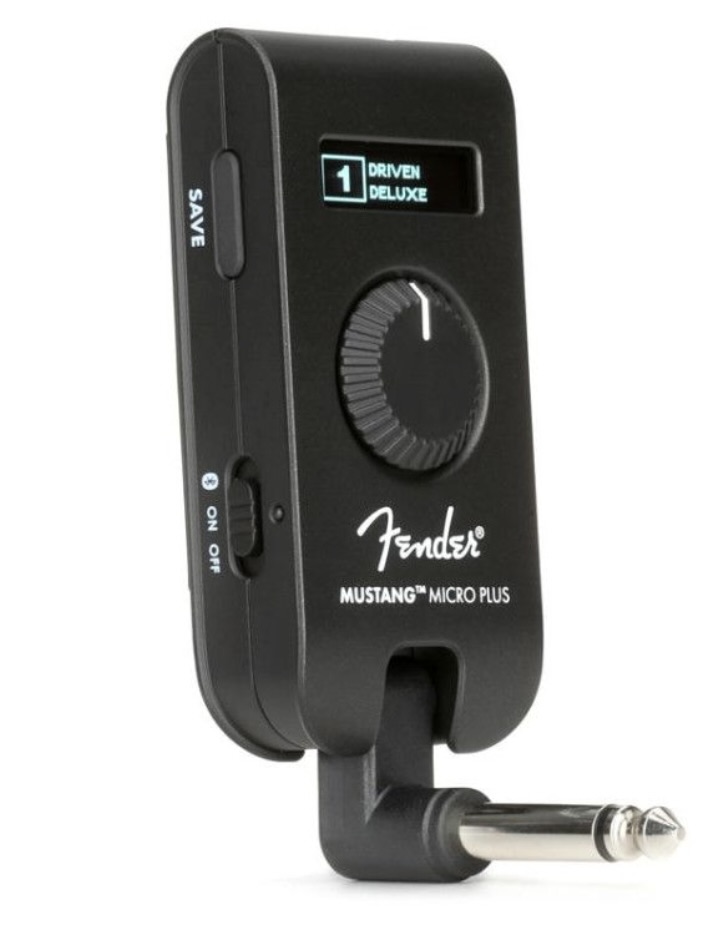
The Mustang Micro Plus solves this by plugging directly into your guitar jack. No cables. No clutter.
This is the ultimate ‘zero-friction’ setup. I often pair the Mustang Micro with my Squier Debut Telecaster for a 10-minute session on the couch. It’s light, simple, and removes every excuse not to practice.
This isn’t the noisy “pocket amp” of the 90s. The Mustang Micro Plus (the updated 2025 version) is a legitimate modeling engine that fits in your palm.
| Feature | Why it matters to you |
| Direct Plug-In | Zero cables. Total freedom to play on the couch or in bed. |
| LCD Screen | No more guessing. Total control over your presets. |
| USB-C Recording | You can plug this straight into your laptop to record riffs. |
| 5-Hour Battery | Enough for a week of late-night practice sessions. |
The Honest Truth (Cons): The plastic housing feels a bit fragile. If you’re a “clumsy” player who drops things frequently, you have to be careful. Also, it won’t work on guitars with deeply recessed jacks (like some Ibanez S-series) without a small extension cable.
The “Pure Silence” rig hits the “Zero Friction” trigger. When the barrier to entry is just “plug in and put on headphones,” you eliminate the excuses. By removing the fear of “disturbing the peace,” you free your brain to take risks, hit wrong notes, and experiment, which is where real growth happens.
Some guitarists simply cannot get inspired by a 4-inch desktop speaker or a pair of headphones. They need to feel the “thump” of a real 12-inch driver moving air.
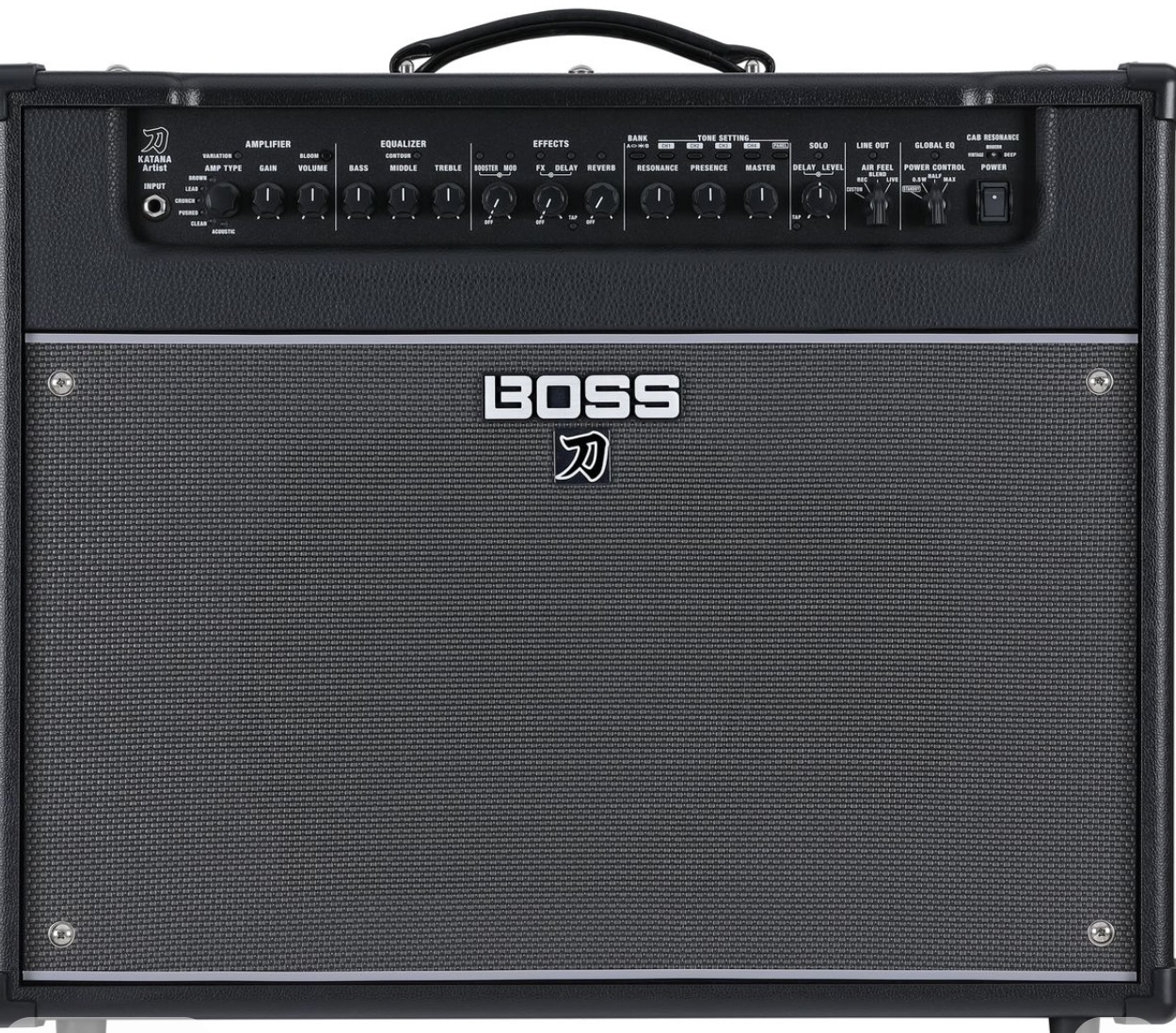
If that’s you, the Boss Katana Gen 3 is the bridge between your bedroom and the stage.
The 12-inch speaker in the Katana is the perfect partner for a classic rock machine. I tested it in a review recently with my Epiphone Les Paul Classic, and the ‘Pushed’ channel delivered exactly that 1980s crunch I was looking for.
The Katana has become the best-selling amp series of the last decade for one reason: it delivers the “Tube Logic” feel of a high-end amp at a fraction of the cost, and it actually sounds good when turned down.
The Katana isn’t just a digital amp; it runs on Boss’s proprietary Tube Logic technology, designed to replicate the organic response of a classic tube power section even at 0.5 Watts.
In the 80s, we used “power attenuators” (expensive boxes that sat between your amp and speaker) to get cranked tones at low volumes. The Katana builds that tech directly into the front panel.
If you’re playing a high-performance instrument like a PRS SE, you want an amp that respects the nuances of those pickups. Read here for my PRS SE Studio review.
The Katana’s 12-inch speaker ensures that the ‘singing’ quality of a PRS isn’t lost just because you’re playing at bedroom levels.
| Feature | Why it matters to you |
| 12-inch Custom Speaker | Provides the “air” and bass response desktop amps lack. |
| 0.5W / 25W / 50W Settings | Instant volume scaling from “bedroom” to “small club.” |
| 60+ Onboard Boss Effects | You don’t need a pedalboard; the best Boss pedals are built-in. |
| Updated Tone Studio | USB-C connection makes deep-editing your patches a breeze. |
The Honest Truth (Cons): It has a much larger footprint than the other options. If you’re tight on space, this might be too much “furniture.” Also, while the 50W model is great, it doesn’t support the advanced GA-FC foot controller (you need the 50 EX or 100W version for that).
The Katana feeds the “Destiny” aspect of your guitar journey. It’s a professional tool.
Owning a “real” amp makes you feel like a “real” performer. It prepares you for the moment you decide to take your skills out of the bedroom and into a rehearsal room or a stage.
If your tone still feels like it’s missing that “singing” quality, you are fighting a battle with physics.
In a stadium, the sheer volume of an amp causes the strings to vibrate longer, a feedback loop that creates natural sustain.
At 2 AM, your strings are on their own. As soon as you hit a note, the volume drops off a cliff.
This isn’t just in your head; it’s physics. The Fletcher-Munson curves prove that our ears perceive frequencies differently as decibels drop, which is why your tone sounds ‘thin’ at 2 AM.
This makes soloing feel like work, and it’s why most bedroom players over-compensate by cranking the “Gain” (distortion) until the tone becomes a fuzzy, unreadable mess.
The “Invisible” Solution: The Compressor Pedal.
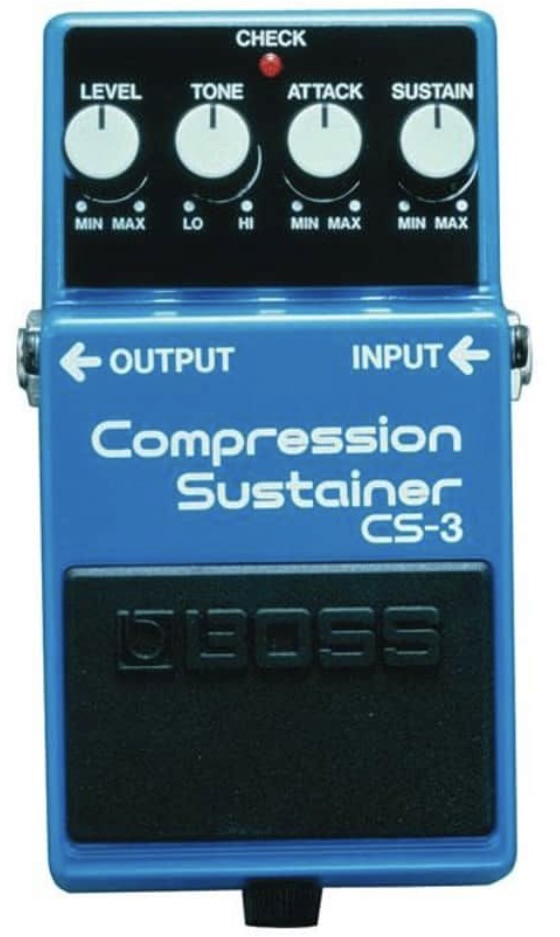
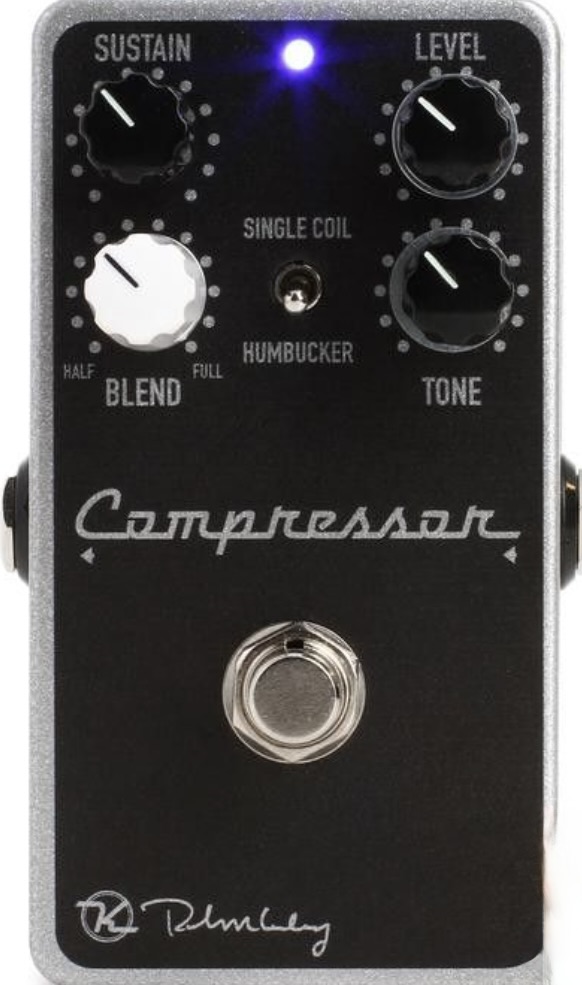
A compressor is the most misunderstood pedal on a board because you don’t “hear” it like a Wah or a Delay. You feel it. It levels out your signal, bringing the quiet “tails” of your notes up and squashing the loud peaks down.
The Workhorse: Boss CS-3 (Compression Sustainer): It’s been on pro boards since 1986. It has a dedicated “Sustain” knob that acts like a cheat code for low-volume playing.
OR
The Modern Standard: Keeley Compressor Plus: This is widely considered the best-performing compressor for the money today.
💡 Run a compressor pedal after the tuner in your chain to even out your signal and to provide a consistent sustain.
As we discussed, persuasive writing lives in the psychology underneath the words. Your tone is the same.
The compressor is the “persuasion cue” for your brain.
When the guitar responds effortlessly to your touch, even at whisper volumes, you stop “thinking” about the gear and start “feeling” the music.
This removes the subconscious friction that causes players to put the guitar back in the stand after five minutes. If it feels like a rockstar rig, you will play like a rockstar.
Check out my recent review on Distortion vs Overdrive pedals.
The real driver behind a successful guitar habit isn’t “discipline”, it’s the removal of friction.
If your gear sounds thin or is a hassle to set up, you won’t play.
By choosing a setup that solves the “Volume Lie,” you aren’t just buying a gadget; you are securing the habit that builds your character as a musician.
Here is the bottom line to help you choose the right path today:
| If you want… | Buy this… | The “Winning” Feature |
| The Ultimate Convenience | Positive Grid Spark 2 | Built-in Looper & AI Tone Search. |
| Total Silence & Portability | Mustang Micro Plus | Zero cables; plays anywhere (even in bed). |
| The “Real Amp” Feel | Boss Katana Gen 3 | 12-inch speaker with 0.5W power scaling. |
| Infinite Sustain (at 2 AM) | Keeley Compressor Plus | Makes a quiet amp feel like a cranked stack. |
Don’t let another “thin-sounding” practice session kill your motivation. Pick the rig that fits your lifestyle, plug in, and finally get the sustain your playing deserves.
Getting your gear right is the first step toward your Guitar Character and Destiny. Once the friction is gone, the real work of building habits begins.
Yes, but you have to solve for compression, not just distortion. Modern digital modeling (like in the Spark 2) and “Tube Logic” (in the Boss Katana) mimic the feel of a cranked amp by faking the physics of sagging tubes.
Adding a compressor pedal to your chain is the “pro secret” to getting that liquid sustain when you can’t push air.
This is the “Volume Lie.” At high volumes, sound waves hit your strings and create a feedback loop of sustain. At 2 AM, your strings are on their own. To fix a thin sound, use a Compressor Sustainer or an amp with Power Scaling (like the 0.5W setting on a Katana) to regain the harmonic richness lost at low decibels.
Standard consumer earbuds (like AirPods) often have a “V-shaped” EQ that makes guitars sound harsh or muddy.
For an authentic tone, use studio monitor headphones with a flat response, such as the Audio-Technica M50x. They ensure you hear the amp model exactly as it was designed, without artificial bass boost.
*

I’ve been playing guitar 40 years now; writing, recording, and rocking in bands. Randy Rhoads, Warren DiMartini, and of course, Jimi Hendrix all lit the fire for me, and I’ve been chasing that passion ever since.


