Have you ever picked up your guitar, played the same two chords, and thought, “Cool… now what?” I’ve been there. It’s not that you lack talent.
Your brain is a prediction machine, as it defaults to those same two chords because they feel safe and familiar. In your subconscious, playing something “new” (and potentially “bad”) feels like a survival threat to your ego.
Your brain isn’t uncreative, it’s just efficient. To find a new riff, you have to convince your brain that making a “bad” sound isn’t a mistake, it’s just data.
In this post, I’ll show you how I turn that messy data into ideas you can call your own.
| The Resolution Trap (Fake Prediction) | The Rockstar Reality (The Path Forward) |
|---|---|
| Goal: “I’m going to write a complete, professional-sounding rock song tonight.” | Goal: “I’m going to find one 3-second ‘mistake’ that sounds cool.” |
| Brain State: High Stress. The “Safety Switch” is on. Fear of failure is high. | Brain State: Low Stakes. Playful mode. The brain feels safe enough to experiment. |
| Focus: Perfection. If it doesn’t sound like the radio, it’s “bad.” | Focus: Data. Every “wrong” note is just a clue to a better one. |
| Outcome: Frustration, choice paralysis, and putting the guitar back in the case. | Outcome: A “Song Seed” recorded on your phone and a win for your consistency. |
When I’m trying to spark creativity, I don’t “wait for inspiration.” Inspiration is a flaky friend.
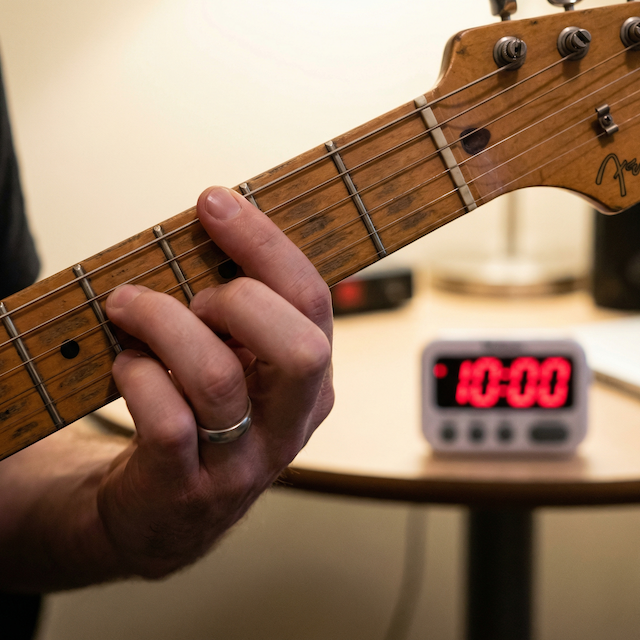
Instead, I set a Neuroscience Trap for it. My 10-minute rule works because it lowers the stakes. By limiting yourself to 10 minutes and one chord, you tell your brain: “We aren’t writing a hit; we’re just playing in the dirt.”
This removes the survival threat of sounding “bad” and lets your inner rockstar out to play.
Here’s my favorite beginner-friendly routine.
The point isn’t to write a masterpiece; it’s to create a Future Memory. By making something repeatable, your brain stops predicting that you’re “just a student” and starts predicting that you’re a “creator.”
If you struggle with consistency, pair this with my effective guitar practice routine. Creativity isn’t a lightning bolt, it’s a habit that shows up when you have a dedicated space to be messy.
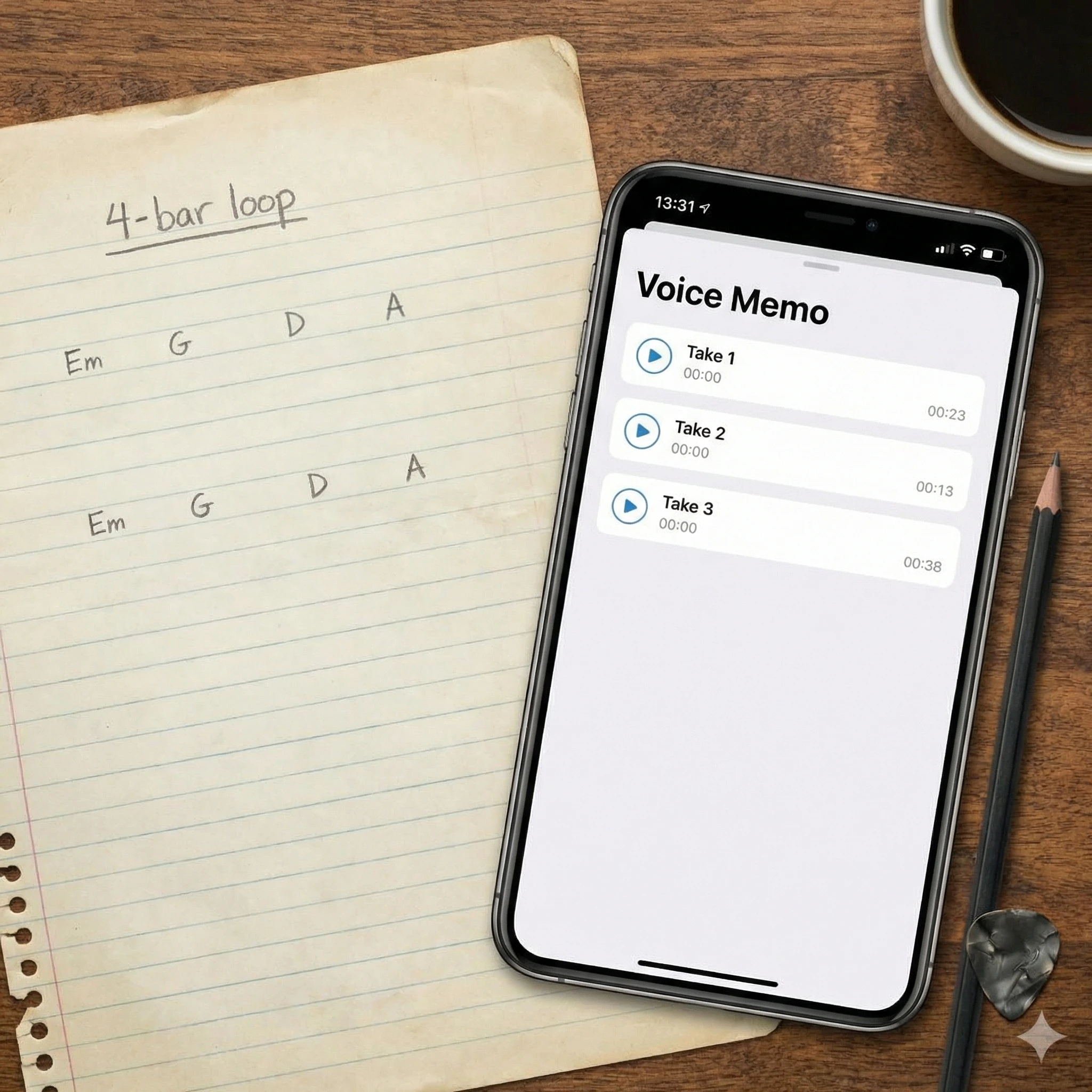
💡Visual ideas that help: a quick “4-bar loop” diagram on paper, and a phone screenshot showing your voice memo takes that are labeled Take 1, Take 2, Take 3 to record the process.
The truth is, creativity doesn’t show up for people who wait for it, it shows up for people who have a place for it to land. If you struggle to find that ‘creative spark’ consistently, it’s usually because your environment is chaotic.
Pair these creative drills with my neuroscience hack daily guitar routine. By having a structured ‘home base’ for your hands, you free up your brain to take risks without feeling overwhelmed.
Structure is the cage that keeps your inner rockstar focused.
Creativity loves limits. Too many options makes your hands freeze up, like standing in front of a vending machine for five minutes, then walking away with nothing.
I use three constraints all the time, and they’re beginner-proof.
I’ll stay on one string and focus on rhythm first. Focusing on rhythm helps you think outside the box when creating riffs and licks. Rhythm is the steering wheel. Notes are the paint job.
Try this: play on the A string only, pick any three frets (like 0(open string), 2, 3), and create a pattern you can hum. Mix it up with (0,0,2,3 or 3,3,2,0). If it’s hummable, it’s usable. Keep it simple!
When you’re ready to turn that into something more “rock,” this guide helps a lot: learn musical composition through catchy guitar riffs. Riffs are basically creativity you can replay on command.
If you “borrow” someone’s notes, you’ll feel weird. If you borrow their rhythm, you’ll learn something.
I’ll take a drum feel from a song (even just a basic chuggy eighth-note pulse), then put my own notes on it. Borrowing rhythm feels helps build your musical language without plagiarism. That’s how I avoid sounding like a bad photocopy.
I’ve watched players spend 40 years waiting for ‘The Big Idea.’ They fail because of the Resolution Trap.
They want the masterpiece without the mess. In 2026, with AI-generated music everywhere, the only thing that matters is your ‘Human Error’, the specific way YOU slide into a note or hesitate on a beat. That’s your brand.
And I love this line because it keeps things simple: “The guitar is a small orchestra.” That’s Andrés Segovia.
To me, it means you don’t need more gear or more theory to create, you need to explore what your hands can already do. These strategies are the first steps toward songwriting.
Start with a “Constraint Loop.” Choose just two chords and one simple rhythm. By limiting your choices, you bypass the “choice paralysis” that freezes most beginners.
No. Theory is the map; your ears are the engine. You can’t drive a map.
Treat it as a “Creative Accent.” It’s normal to copy your heroes when you’re building your musical vocabulary. To break the “sounds like” zone, change the rhythm of the riff first, then change the starting note.
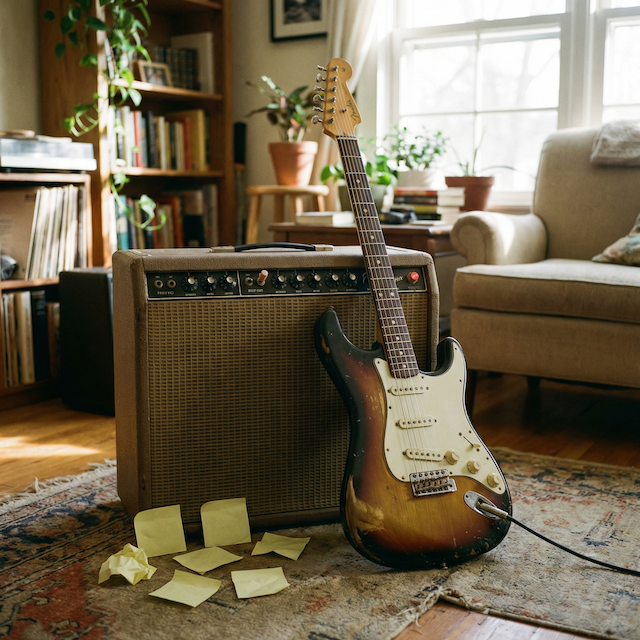
Most beginners don’t lack ideas, they just kill them too early.
Your brain is a prediction machine, and it predicts that a “wrong note” is a failure. To protect you, it switches on the “Perfectionism” light, which freezes your hands and stops your flow.
I still catch myself doing this after 40 years. Here is how I trick my brain into staying in the creative zone.
Here are a few things that keep me productive.
First, Use a Mental Partition: Idea Time vs. Edit Time
You cannot create and judge at the same time. It’s like trying to drive with the emergency brake on.
By separating these, you remove the Resolution Trap. You aren’t trying to “write a song” (which feels huge and scary), you’re just capturing “raw data” to fix later.
Master “Minimum Viable Technique”
Don’t let a lack of speed stop a great idea. If you’re not sure whether to downpick or alternate pick, choose the one that feels most natural in the moment.
Refining the technical “pro sound” comes during Edit Time. Don’t let a technical struggle predict a creative failure.
Kill the “Friction” to Update your Prediction
If it takes 10 minutes to set up your gear, your brain will predict that playing is “hard work” and convince you to watch TV instead.
You need to manufacture a “Future Memory” of playing being easy. I use gear that lets me plug in and play in under 30 seconds.
Here are three beginner-friendly picks and practice tools I honestly like, with quick pros and cons:
| Gear | Pros | Cons | Best for |
|---|---|---|---|
| Positive Grid Spark GO | Tiny, fast setup, fun tones | Small speaker feel | Practice anywhere |
| Boss Katana-50 MkII | Clear sound, great for rock | More amp than some need | Home practice and jams |
| Dunlop Tortex Picks | Cheap, consistent, easy grip | You’ll want to test sizes | Riffs and licks |
One more thought I keep taped to my brain: “The beautiful thing about learning is that nobody can take it away from you.” That’s B.B. King. Your first riffs might be clunky, but they’re yours.
⚡️If you are a total day-one beginner, a tool like Simply Guitar is a great way to learn the basic coordinates of the fretboard. It makes the boring stuff feel like a game.
But remember: an app can teach you where the notes are; only YOU can decide what they mean. Use the app to build the muscle, then use my 10-minute routine to find the soul.
If you try one thing from this post, change your environment by doing the 10-minute loop routine tonight in a different room and record three takes. Tomorrow, listen back and steal the best 3 seconds.
When you hear that 3-second ‘gold’ tomorrow, your brain will stop predicting you’re a ‘beginner’ and start predicting you’re a ‘creator.’ That shift in identity is where the real progress happens.
When you’re ready to turn those scraps into real riffs, use this to guide your next session: riff creation tips for beginners.
Once you have a few ideas, collaborate with others by finding a partner to see how they grow. If you want a simple practice setup that makes it easier to play every day, I’d start with the Spark GO.
And if you’re on String Shock regularly, sign up for the newsletter on the site so I can send you more beginner-friendly creative drills.
Creativity is the spark, but a solid routine is the fuel. If you’re ready to stop “noodling” and start playing with purpose, do these two things:
“The best time to record a riff was 40 years ago. The second best time is tonight during your 10-minute session.” — String Shock Steve

I’ve been playing guitar 40 years now; writing, recording, and rocking in bands. Randy Rhoads, Warren DiMartini, and of course, Jimi Hendrix all lit the fire for me, and I’ve been chasing that passion ever since.


