If you only have 30 seconds, here is the “Natural Authority” formula for a professional rock sound:
⚡️String Shock Steve Perspective: I spent my first decade thinking I needed more pedals. I eventually realized that a $3,000 rig sounds like a toy if you haven’t mastered the “Persuasion Cues” of your own touch. Tone starts in the mind, travels to the fingers, and is only amplified by the gear.

Most beginners believe that a “pro” sound is something you buy at a guitar store. Believe me, I’m not immune to this either.
They think if they just had that $2,000 Gibson or that specific boutique pedal, the “Siren song” of rock would finally come out of their speakers.
After 40 years of chasing the dragon, I can tell you the truth: Tone is an identity, not a transaction.
Your brain is constantly predicting what a “rockstar” should sound like based on the legends you grew up with.
When you sit down to play a Led Zeppelin riff, your brain “predicts” a certain weight, sustain, and growl based on the records you’ve heard a thousand times.
When your current gear produces a thin, buzzy, or “small” sound, it creates a psychological disconnect.
You don’t feel like a player, so you don’t play like one. Crafting your first pro tone is about closing that gap and making the sound in the room match the “prediction” in your head.
Eventually, you’ll put the guitar down because it doesn’t “feel” like rock and roll.
To move from a beginner sound to a pro tone, you have to stop “trying” to sound good and start assuming the identity of someone who already does.
This means setting up your environment so that a professional, inspiring sound is your default setting.
When the tone in the room finally matches the tone in your soul, your brain stops fighting the gear and starts focusing on the music. That’s the moment you stop being a “student” and start being a guitar player.
For a deeper dive into how your brain intertwines with your playing, read The Neuroscience Hack to Build a Daily Guitar Routine.
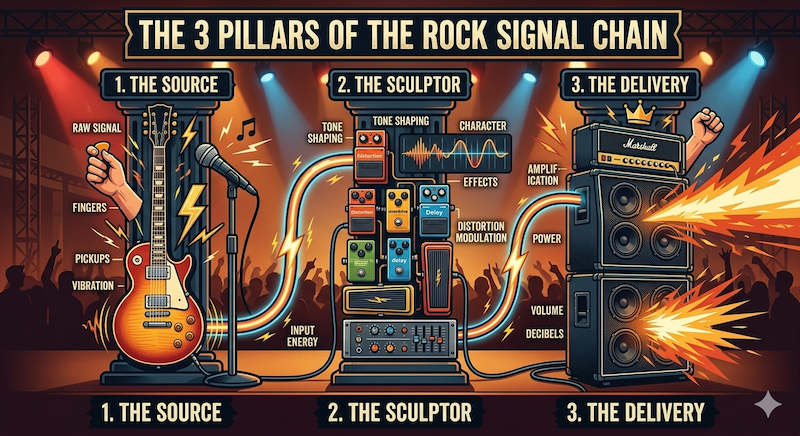
To master your sound, you have to understand the journey of the vibration. It starts in your fingertips and ends in the air moving out of the cabinet.
Everything starts with the physical vibration of the string. Beginners often overlook how much “Tone” is actually in the fingertips.
The way you fret a note, the angle of your pick, and the intensity of your vibrato are the “High-Value Signals” that no pedal can fake.
This is where you add the “Persuasion Cues” to your sound. Distortion, delay, and wah-wah are the colors on your palette.
Read more on pedals here: 7 Must-Have Rock Guitar Pedals Every Beginner Should Try.
The amp is the most critical pillar. It is the “Reality” of your sound. You can play a $5,000 Custom Shop guitar through a $50 practice amp, and it will sound like a $50 practice amp.
For most “comeback” players, a high-quality modeling amp is the smartest investment because it allows you to explore hundreds of tones at “bedroom” volumes.
⚡️Read one of my latest amp comparison review: Boss Katana 50 vs Fender Mustang LT50
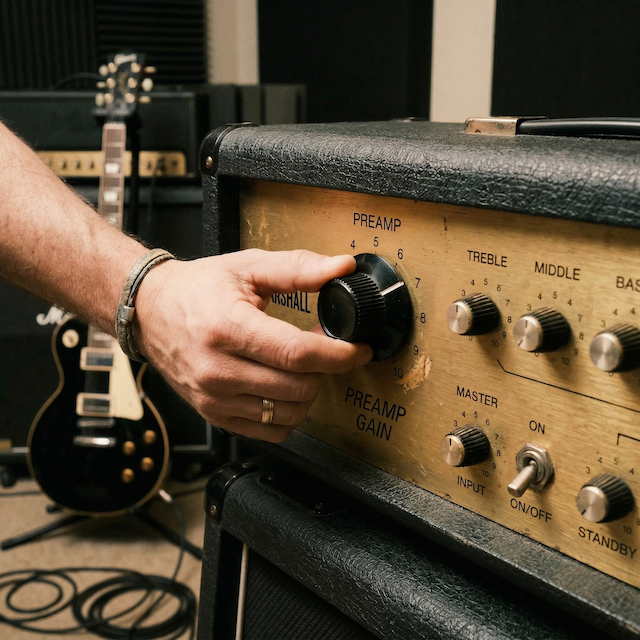
If there is one mistake I see every “comeback” player and beginner make, it’s the Gain Trap.
When we want to sound “heavy,” our natural instinct is to dim the gain to 10. In your head, you think more gain equals more power.
In reality, too much gain compresses your signal into a mushy, fizzy mess. It hides your mistakes, sure, but it also kills your “Information Gain”, the unique nuances of your playing.
💡The Pro Move: Back the gain off to about 6 or 7. Use your attack to create the heaviness. This creates a “Quantum Shift” in your sound, providing the clarity needed for listeners to actually hear the notes in your chords.
Mastering this balance is a core part of The String Shock Method, where we focus on touch as much as technology.
When you oversaturate your signal, you lose String Separation. If you play a complex chord with the gain maxed out, it sounds like a swarm of bees.
If you back that gain off to 6 or 7, you can hear every individual note within the chord.
By lowering the gain, you allow the Attack of your pick to create the heaviness. This is the secret of the greats, from AC/DC to Led Zeppelin. Their tone isn’t actually as “distorted” as you think. It’s punchy, clear, and massive because the amp has room to breathe.
A good rule of thumb I’ve used for 40 years: Find the amount of gain you think you need, and then turn it down by 30%.
The Gain Trap often goes hand-in-hand with too much Treble. High gain plus high treble equals a sound that fatigues the ear.
When you drop the gain, you’ll notice the “harshness” disappears, leaving behind a thick, professional “High-Value Signal” that sounds like a record.
If you look at most beginner guitarists, their volume and tone knobs are dimed to 10 and never move. They treat their guitar like an “on/off” switch and look to their pedals or amp to change the sound.
After many many years of playing, I can tell you that the most powerful EQ and gain control in your entire rig is the one literally under your hand.
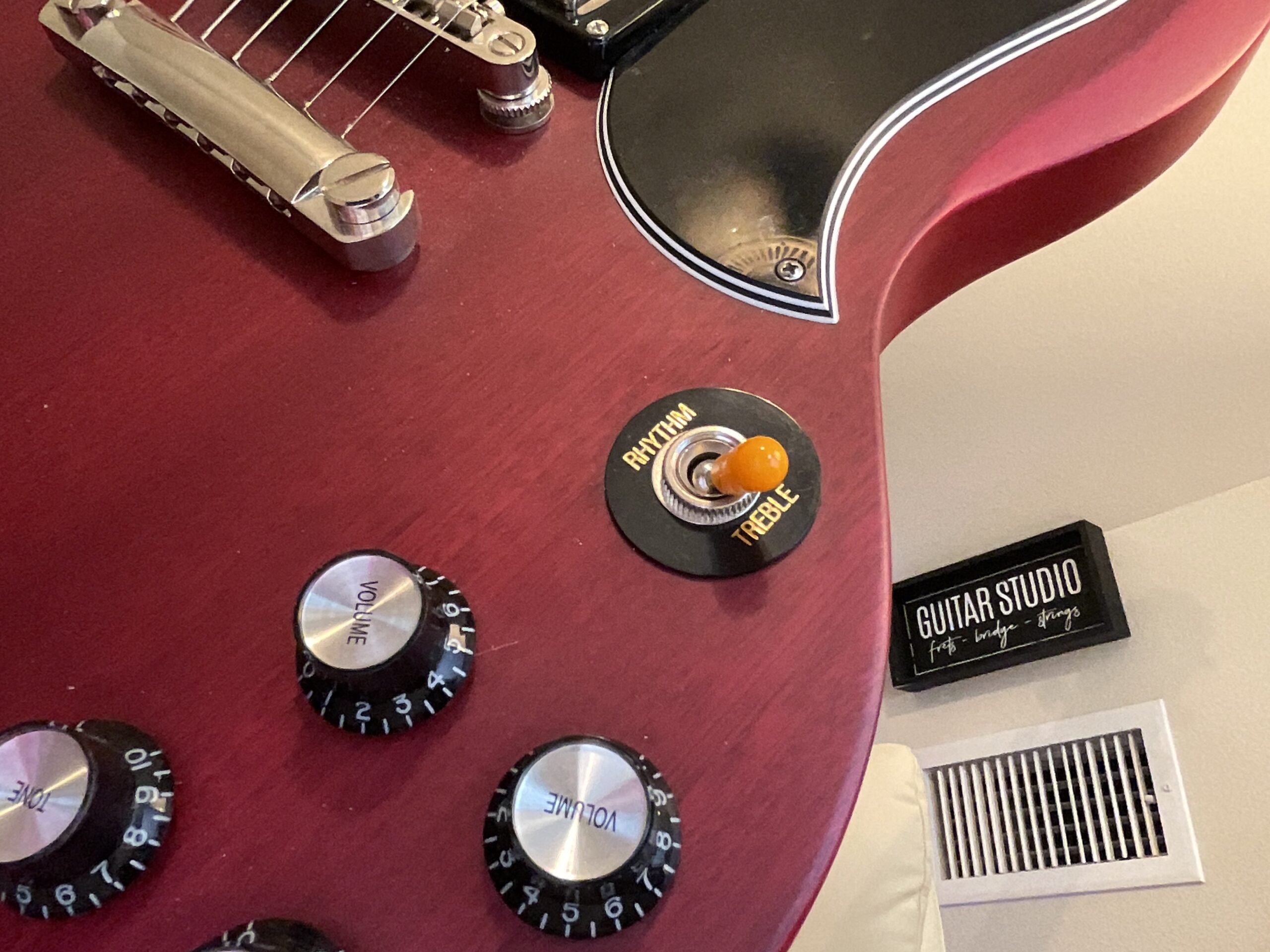
The volume knob on your guitar doesn’t just make things quieter; it changes the texture of your distortion.
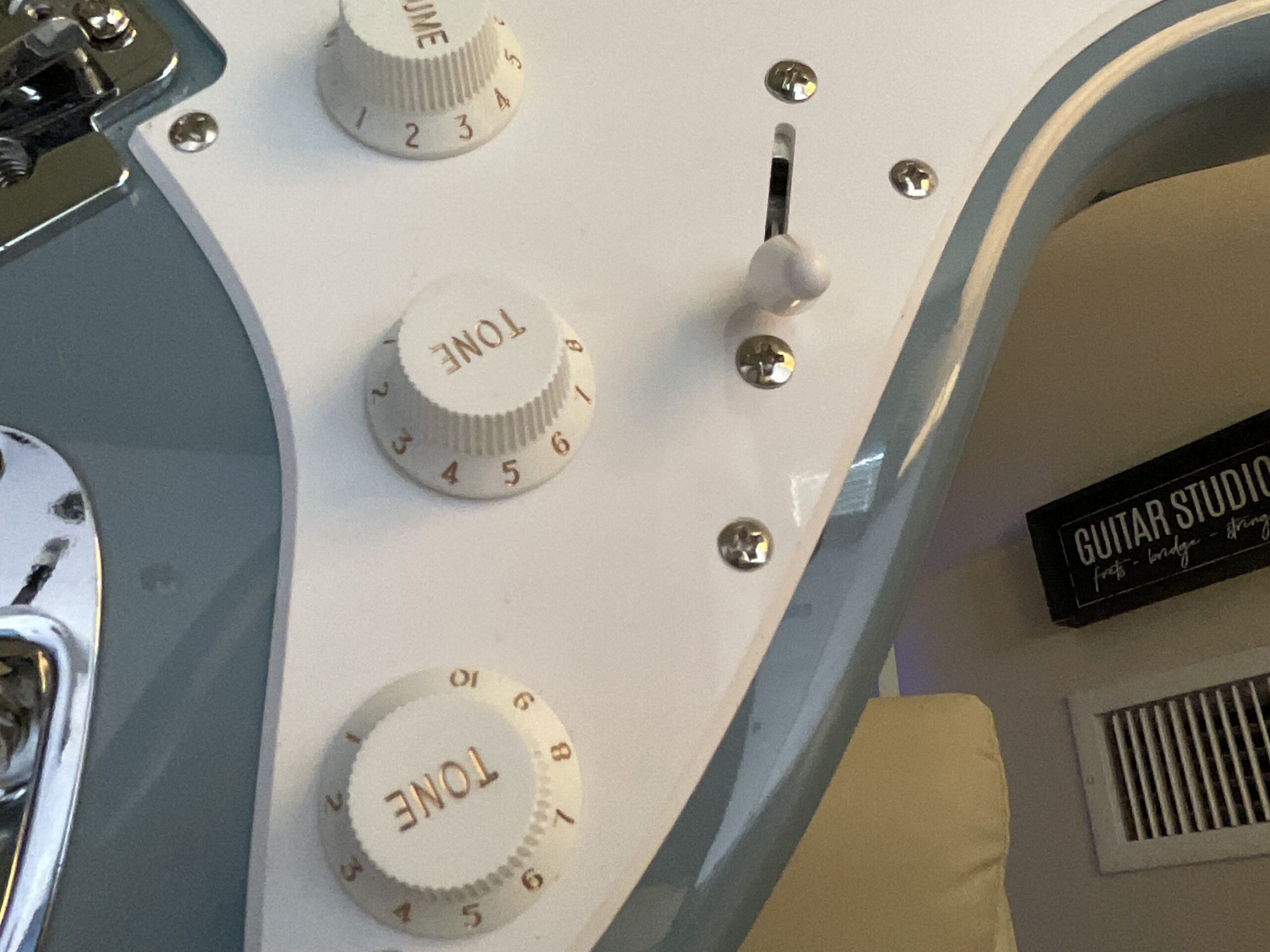
The tone knob is often the most neglected part of the guitar. Most players think it just makes the guitar sound “muddy.”
However, its real job is to roll off those harsh, “ice pick” high frequencies that can make an electric guitar sound cheap or thin.
Your brain is a prediction machine that likes “safety.” It feels safe keeping everything at 10 because that’s the “loudest” and “clearest” setting. But the real “High-Value Signal” happens in the nuances.
By learning to “work the knobs,” you aren’t just playing a guitar, you are conducting an orchestra.
You’re giving your audience (and your own brain) a wider range of dynamics to latch onto, making your performance feel professional and intentional.
The “Scooped Mids” look is famous in metal, but for classic rock and modern blues, the mids are your best friend.
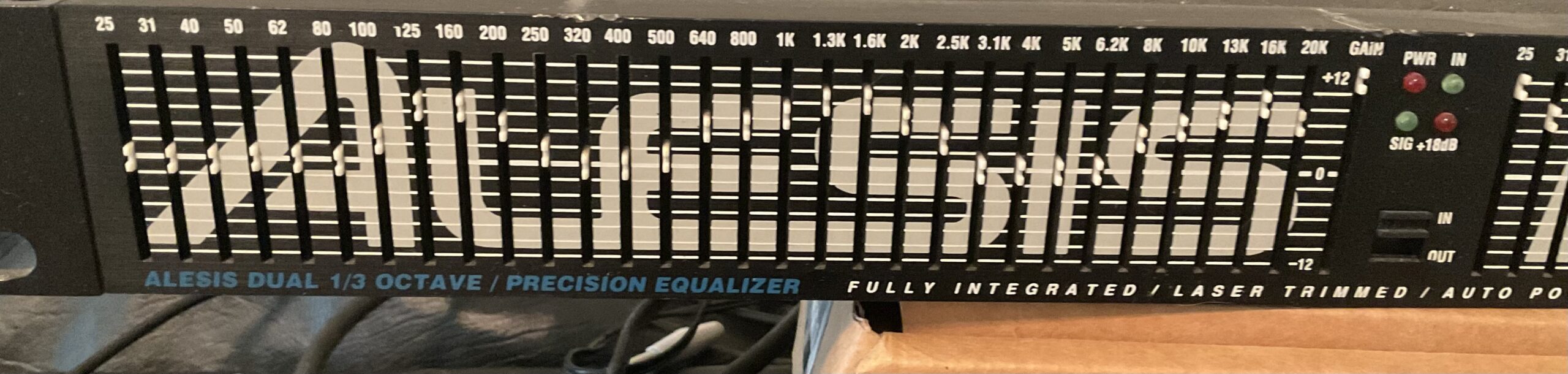
Every instrument in a rock band has its own “neighborhood” in the frequency spectrum:
If you scoop your mids to 0, you are effectively “evicting” yourself from your own neighborhood.
You’ll end up fighting the bass player for the low end and the cymbals for the high end, and you’ll wonder why your guitar sounds thin and distant.
To get that satisfying, percussive “chug” for rock and metal, you need the right balance:
Many modern amps have a Presence knob. Think of this as the “Air” around the sound.
While Treble adjusts the high frequencies of the signal, Presence adjusts the high frequencies of the power amp.
Turning this up slightly can give your tone a “High-Value Signal” that feels like it’s jumping out of the speaker.
I’ve seen countless guitarists buy a new pedal every month, searching for a “magic bullet” that will finally make them sound like a professional.
They are stuck in a loop of reacting to a sound they don’t like, rather than creating the sound they want.
Your brain defaults to what is familiar. If you have spent years playing with a thin, buzzy, bedroom tone, your brain has “memorized” that as your identity.
When you try to dial in a big, professional, mid-forward rock tone, it might actually feel “wrong” or “uncomfortable” at first because it’s unfamiliar.
This is the Resolution Trap. You set a goal to have a “pro sound,” but because that sound doesn’t have emotional weight yet, your brain subconsciously pulls you back to the old, fizzy settings you’re used to.
To shift your “Natural Authority,” you must make your desired future sound more familiar than your past mistakes.
Don’t settle for “okay” sounds.
Spend the extra five minutes tweaking your EQ until the sound in the room feels more familiar than the frustration of a “beginner” tone.
Once your brain accepts this new reality, your confidence will skyrocket, and your “destiny” as a guitar player will begin to take shape.
| FAQs: Crafting Your First Pro Rock Tone | |
|---|---|
| Do I need an expensive tube amp to get a pro tone? | Not anymore. Modern modeling amps and high-quality solid-state gear can get you 95% of the way there at a fraction of the cost. |
| Why does my guitar sound “fizzy” when I record it? | This is usually the “Gain Trap” in action. High gain sounds different through a microphone than it does in a room. Try backing the gain off significantly when recording. |
| What is the best “first pedal” for rock? | An Overdrive pedal. It allows you to push your amp into that natural “crunch” without needing to play at stadium volumes. |
| What is the fastest way to practice these tone techniques? | The best way to learn is by playing along with real tracks. I often recommend Simply Guitar for beginners who want a guided path to mastering the fretboard while applying these professional tone settings in real-time. |

I’ve been playing guitar 40 years now; writing, recording, and rocking in bands. Randy Rhoads, Warren DiMartini, and of course, Jimi Hendrix all lit the fire for me, and I’ve been chasing that passion ever since.


