

You bought the gear. You learned a few chords. You swore this was the year you were finally going to unleash your inner rockstar and play with true passion.
But right now, that guitar is back on the stand, collecting dust.
If you are frustrated, stop beating yourself up. You’re not lazy, and you don’t lack talent. The real driver behind your struggle isn’t a lack of willpower, it’s the psychology operating underneath the surface.
You are fighting your own biology, and to win, you need to understand the neuroscience of habit.

Most beginners quit, not because they lack musical ability, but disorganized practice and a lack of emotional connection to their goals cause their brains to default to old, comfortable habits.
When a practice routine lacks structure and psychological safety, the brain rejects the new identity of being a musician and drags the player back to their familiar, non-playing routine.

As highlighted by mindset expert Mitch Behan, your brain isn’t just a filing cabinet remembering your past. It is an active prediction machine constantly guessing what comes next.
In the eyes of your nervous system, familiar equals survival.
Your brain defaults to old habits and identities simply because the known past feels safe.
Even if your current routine is exactly what is keeping your favorite guitar unplayed in the corner, your brain prefers it because it knows exactly how that story ends.
When you try to force a new daily practice schedule without changing the psychology underneath, you are stepping into the unknown.
Your brain perceives this new identity of a dedicated guitarist as unfamiliar, and therefore, a threat. So, it fights back. It drags you right back into your comfortable, non-playing habits.
This is why relying purely on willpower or forced discipline fails.
People quit because their goal of playing guitar lacks real emotional weight. You can stare at tabs or buy new gear all day, but your brain will not follow a vision it isn’t emotionally connected to.
The root solution to building a lasting routine isn’t just forcing your fingers to move, it is shifting the psychological safety of your new identity.

To break the cycle of starting and stopping, you must hack your brain’s prediction machine.
The goal is simple but profound: Make your future reality as a guitarist feel more familiar than your past. When your brain trusts a new outcome, it will automatically pull you toward it. Here is how you rewire your approach:
If your only goal is to “learn the minor pentatonic scale,” your nervous system doesn’t care. To bypass the brain’s resistance, you must attach a specific, highly charged emotion to the action.
Don’t just practice mechanically. Visualize the exact feeling of locking into a groove, playing a flawless solo, and unleashing your inner rockstar. You must give your brain a reason to care about the hard work.

Your brain builds your identity around what it predicts will happen next.
To change that prediction, give your brain a “memory” of a future that hasn’t happened yet. When you rehearse your success and clearly define your goals, your brain upgrades its programming.
It stops dragging you back to your old, non-playing habits because your new future finally feels safer and more recognizable than your past.
A chaotic, disorganized practice session triggers frustration, sending a signal to your brain that playing guitar is unsafe and a waste of energy.
To lock in this new identity, your brain requires structure.
A predictable, balanced routine that dedicates precise time to the “heavy lifting” of technical skills and the “cardio” of actually playing fun songs. This gives your nervous system the exact organization it craves.
This is the exact sequence of success. Mindset is the very foundation of creating strong habits.
💡Thoughts become words. Words become actions. Actions become habits. Habits become character. Character becomes destiny. (Lao Tzu -philosopher)
By hacking your brain’s prediction machine, you lay the ultimate groundwork for those habits to finally take root.
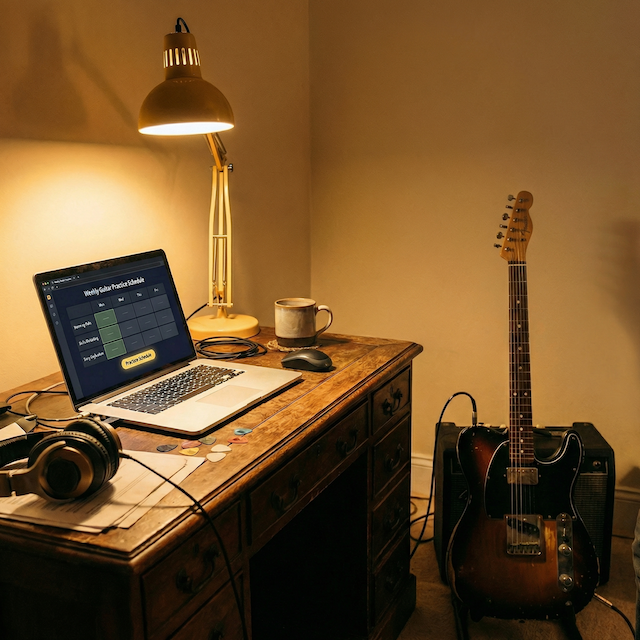
You now know that disorganized practice is the #1 reason beginners quit.
When you sit down, waste ten minutes deciding what to play, noodle around, and put the guitar away feeling stuck, you are teaching your brain that the guitar is a source of frustration.
To make your future reality safe and familiar, you need a system that does the thinking for you.
After four decades of playing, recording, and teaching, I realized that consistency and organization beat raw talent every single time. That is why I built String Shock Steve’s Formula: Rock Guitar Practice Schedule Generator.
This tool is designed to provide your brain with the exact predictability it craves. By entering your skill level, available time, and goals, the generator instantly builds a balanced, personalized routine. It gives you the perfect ratio of:
It eliminates the guesswork. It upgrades your brain’s prediction. And most importantly, it gets you actually playing the guitar instead of just staring at it.
Stop fighting your own psychology. Change the prediction, and the playing will follow.
Click Here to Generate Your Custom Rock Guitar Practice Schedule Instantly.
Once your custom routine is locked in, you need to execute the “Application & Fun” phase. This is where you reward your brain by actually playing music.
I highly recommend using a guided tool like Simply Guitar. It perfectly complements your new schedule by giving you step-by-step, interactive song lessons that keep your brain engaged and emotionally connected to your progress. Read my Simply Guitar App Review here to see if it’s right for you.
Stop fighting your own psychology. Change the prediction, get the right tools, and the playing will follow.
Keep rocking, and as always, HAVE FUN!
String Shock Steve ⚡

I’ve been playing guitar 40 years now; writing, recording, and rocking in bands. Randy Rhoads, Warren DiMartini, and of course, Jimi Hendrix all lit the fire for me, and I’ve been chasing that passion ever since.


