
Five Alternate Picking Drills for Beginner Rock Guitarists, From Open Strings to Real Riffs
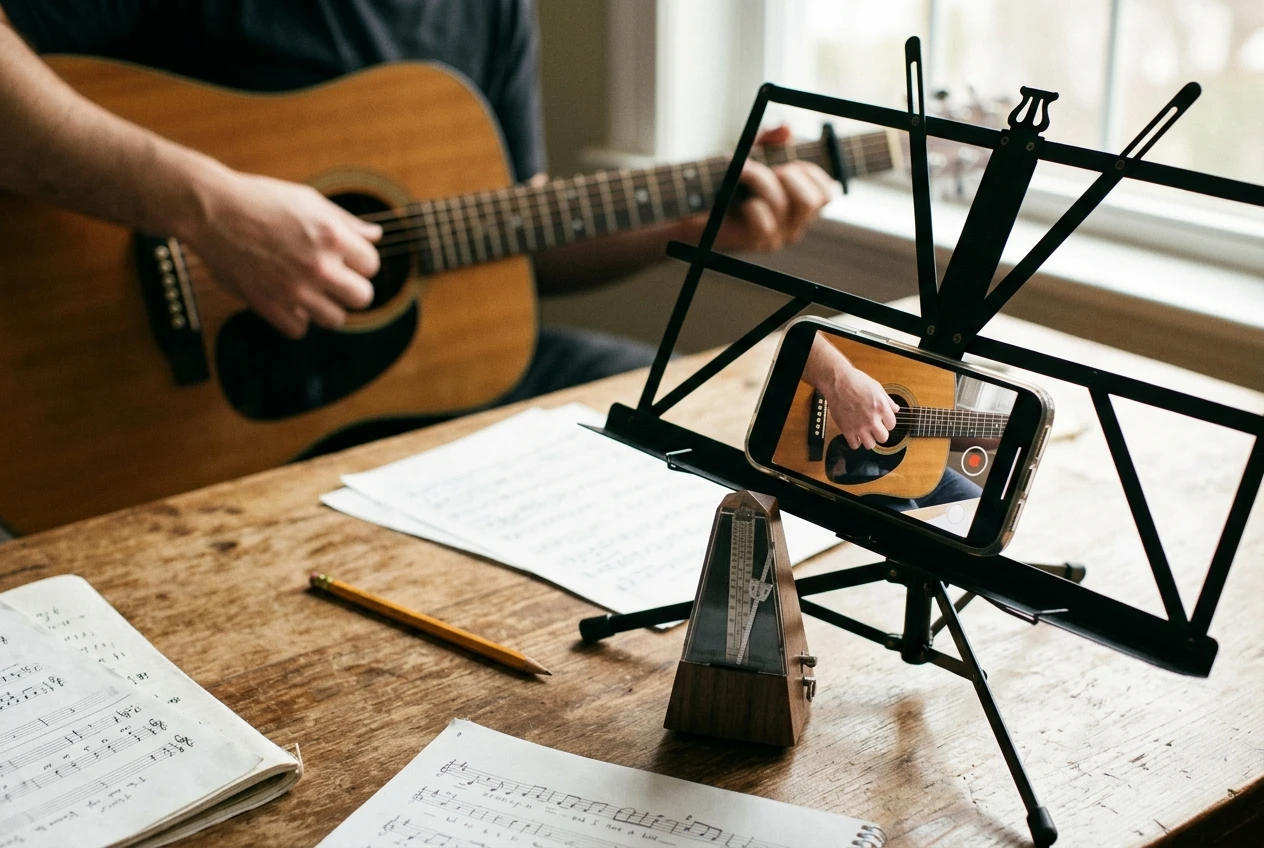
Alternate picking means every downstroke is followed by an upstroke, and the pick never stops moving in that pattern, even when a note is silent. These alternate picking exercises for beginners are five drills in a fixed order. Each one adds a single new demand to the one before it: first clean strokes on one string, then string crossing, then fretting, then a real riff, then skipped strings and accents.
Every drill comes with a tempo ladder, a list of metronome speeds that tells you when to move up and when to stay put. You will need a guitar, a pick, and a metronome (a phone app works). The tempo rules are collected near the end, and the final section fits all five drills into ten minutes.
Set up your picking hand before you start the clock
Most speed problems in the first months come from tension and pick position, not from a lack of practice time. Spend a few minutes on the basics before you turn the metronome on.
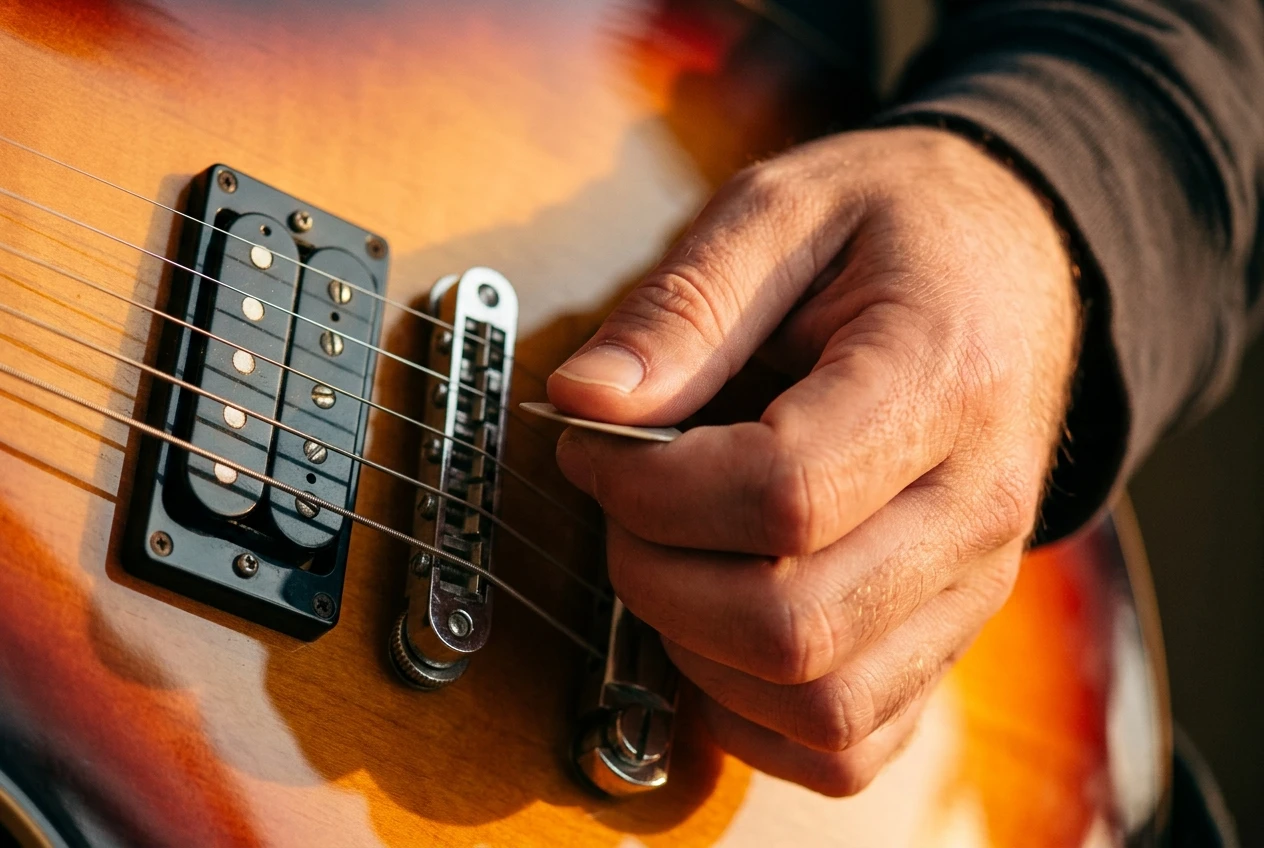
- Grip: Hold the pick between the pad of your thumb and the side of your index finger. Let only a few millimeters of the tip show past your fingers. A long exposed tip catches on the string and slows each stroke.
- Pick angle: Tilt the pick slightly so its edge, not its flat face, meets the string. A tilt of a few degrees lets the pick slide across the string instead of dragging against it.
- Motion: Most of the movement should come from the wrist, with a small contribution from the forearm. If your whole arm swings, the stroke is too large for the speeds you are aiming at.
- Depth: Aim for the pick to pass just beyond the string on each stroke. Digging deep into the strings makes every stroke slower, because the pick has to travel farther to get back.
- Tension: Your grip should be firm enough to keep the pick from slipping and no firmer. Shake out your hand between drills. If your forearm burns or your shoulder rises, stop and lower the tempo.
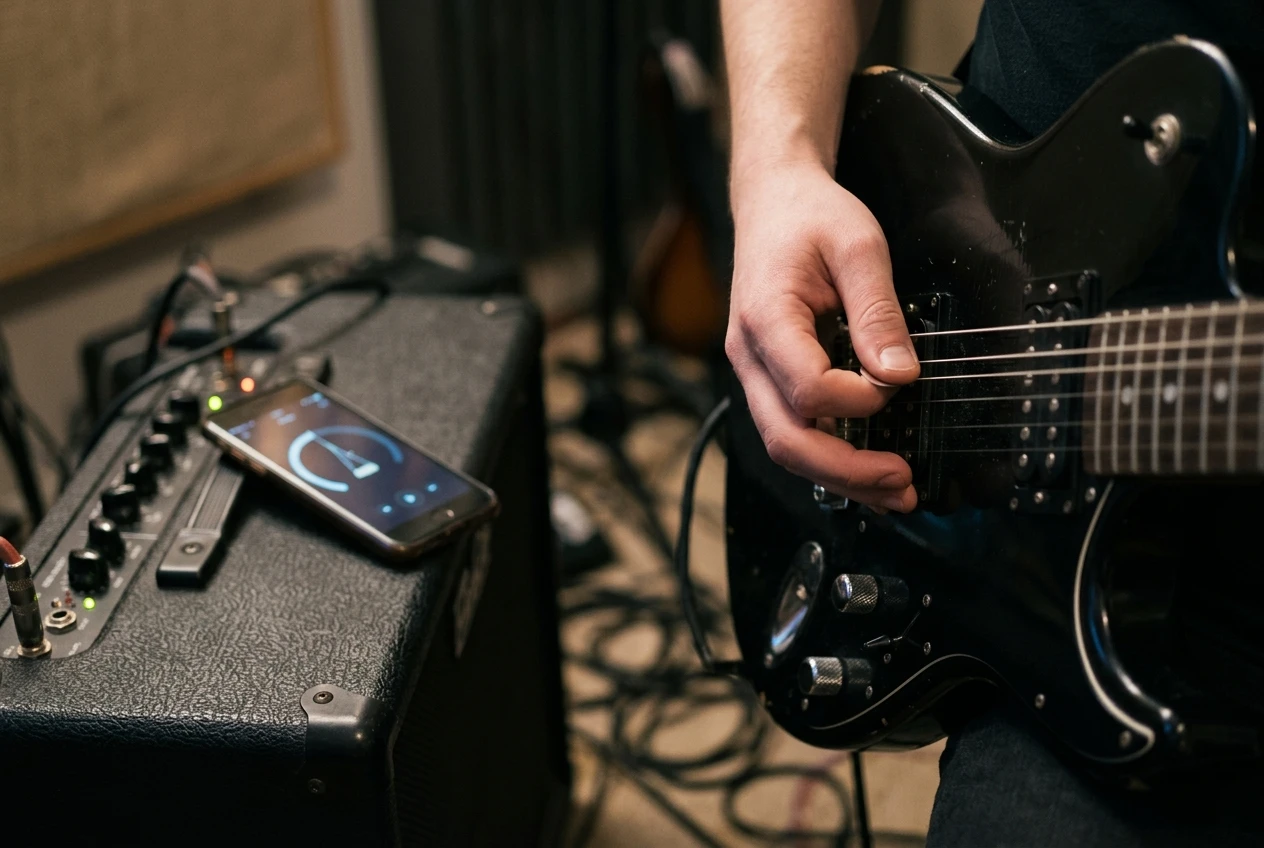
Set the metronome to count eighth notes if the app allows it. If it only clicks quarter notes, you will play two strokes per click: a downstroke on the click and an upstroke between clicks. Say “one and two and three and four and” out loud at first so the downstrokes land on the numbers and the upstrokes on the “ands”.
Drill 1: One open string, strict down-up strokes
Pick the open high E string or the open A string. Play eighth notes: down on the click, up on the “and”, for the full length of every bar.
Your goal is even strokes that sound identical. Listen for the upstroke being quieter or weaker than the downstroke, since that is the most common imbalance. Also watch for the upstroke missing the string entirely. If you hear a gap or a thin sound on every second note, your upstroke is too shallow or your pick angle is off.
A “clean pass” in this article means eight bars of 4/4 (64 strokes) with no missed notes, no uneven volume, and no stopping the pick. Three clean passes in a row at one tempo means you are ready for the next rung.
Tempo ladder for Drill 1 (eighth notes): 60, 66, 72, 80, 88, 96, 104, 112, 120 bpm.
Start at 60 even if it feels slow. The slow speed is where you learn what a clean stroke feels like, and that feel is what you will hold onto when the tempo rises.
Drill 2: Open string pairs to build string crossing
String crossing is where alternate picking usually first falls apart. The pick has to leave one string and reach another without losing its place in the down-up pattern. This drill removes the fretting hand so you can work on the crossing by itself.
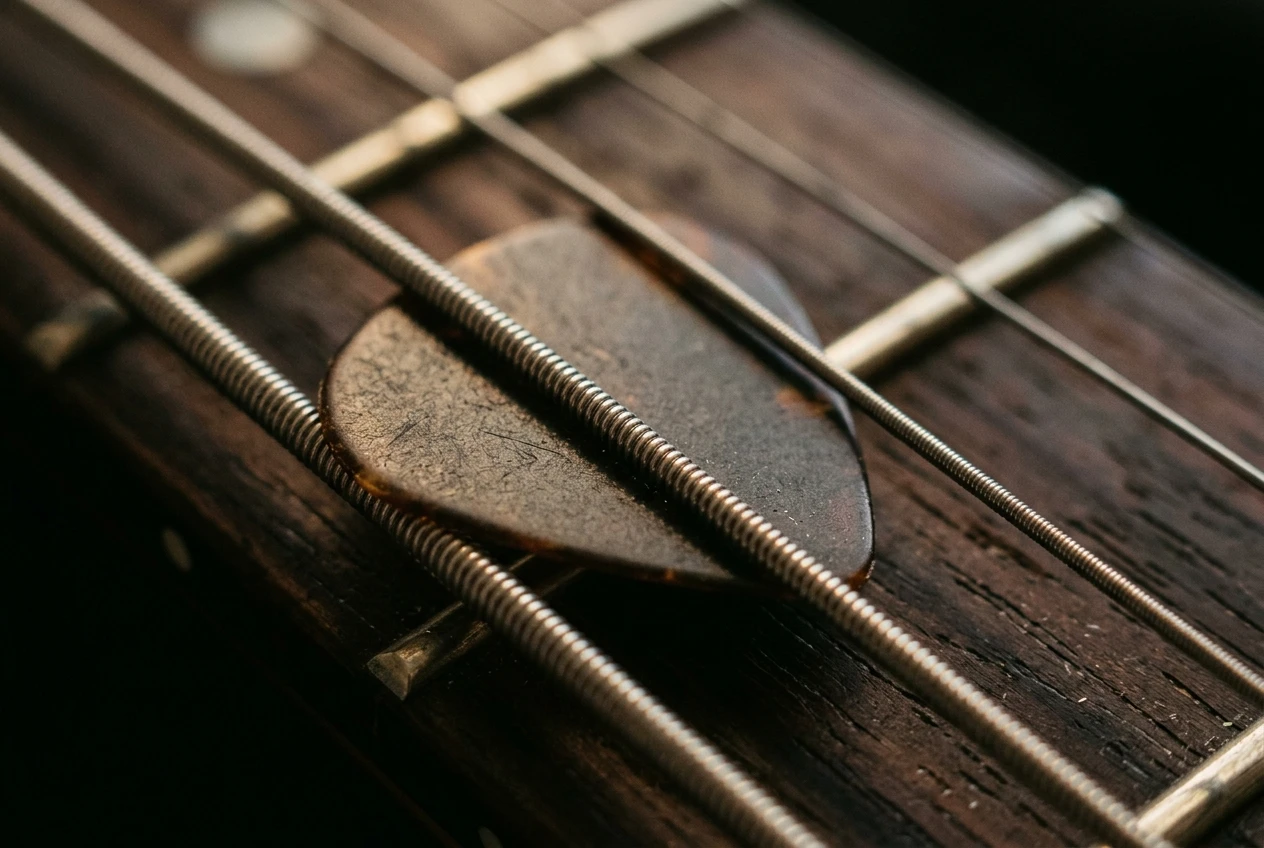
Use two neighboring open strings, such as A and D. Work through three versions in order:
- Four strokes per string. Play down-up-down-up on the A string, then down-up-down-up on the D string, and repeat. Each string gets a full bar of eighth notes in 2/4, or half a bar in 4/4.
- Two strokes per string. Play down-up on A, then down-up on D. You now cross strings twice as often.
- One stroke per string. Play a downstroke on A, an upstroke on D, a downstroke on A, and so on. This version asks the most of your pick because every stroke is a crossing.
Move to a different pair of strings once you can play all three versions cleanly, for example D and G, then G and B. The strings are closer together in the higher pairs, so notice whether your pick hits a third string by accident.
Tempo ladder for Drill 2 (eighth notes): 60, 66, 72, 80, 88, 96, 104 bpm. Climb each version separately. A version you have not played before starts at 60, even if the version before it is already at 90.
Drill 3: The one-two-three-four fretted pattern across strings
This is the standard chromatic exercise. Your fretting hand plays four adjacent frets, one finger per fret, and your picking hand has to stay in sync with it.
Place your index finger on the fifth fret of the low E string, then play fifth, sixth, seventh and eighth frets with your index, middle, ring and pinky fingers. Starting at the fifth fret rather than the first gives your fingers more room, which is easier on a beginner’s hand. Each note is one eighth note, so the four notes use down-up-down-up.
Then move to the A string and play the same four notes, starting again on a downstroke. Because each string gets exactly four notes, every string begins on a downstroke and the pattern stays predictable. Work through all six strings, and then come back down in reverse order, still four notes per string.
Two things to watch:
- Press just behind the fret, with the tip of your finger, so that each note rings without buzzing.
- Keep your fingers close to the fretboard between notes. Fingers that fly away from the strings cost you time on every change.
Because both hands are working now, start at a lower speed than in Drills 1 and 2.
Tempo ladder for Drill 3 (eighth notes): 50, 56, 63, 69, 76, 84, 92, 100 bpm.
Drill 4: Turning a simple rock riff into an alternate picking drill
The first three drills train mechanics. This one puts them into something that sounds like rock guitar. The riff below is written for this exercise and uses only open strings and a few low frets. Play it as straight eighth notes.
E|----------------|----------------|
B|----------------|----------------|
G|----------------|----------------|
D|----------------|----------------|
A|----------------|0-0-0-2-0-0-3-2-|
E|0-0-0-3-0-0-5-3-|----------------|
Each bar has eight notes, so the picking is down-up-down-up-down-up-down-up in both bars. Loop the two bars without a pause. The jump from the E string to the A string at the bar line is a string crossing, and it falls on a downstroke.
Three points make this drill useful rather than just repetitive:
- Keep the pick moving. If the riff has you play two notes on the same fret in a row, you still alternate strokes. Never switch to all downstrokes to make a phrase easier.
- Try palm muting. Rest the edge of your picking hand lightly on the strings near the bridge. The muted sound is typical of rock rhythm playing and also exposes uneven picking, because every stroke is audible.
- Change the riff. Once the first version is clean, move the whole pattern to a different starting note, or write your own two-bar riff using the same rhythm. Your own riff will not be exactly as easy or hard, which is the point.
Tempo ladder for Drill 4 (eighth notes): 60, 66, 72, 80, 88, 96, 104, 112 bpm.
Drill 5: Skipping strings and accenting the offbeats
Rock riffs often jump over a string, and they often lean on the upstrokes. This drill trains both skills at once.
Part A: skipping a string. Use the open A string and the open G string and skip the D string between them. Play a downstroke on A and an upstroke on G, and repeat. Your pick has to pass over the D string each time without touching it. Then try low E and D, skipping A, and D and B, skipping G.
Part B: accenting the upstrokes. Play the same pattern, but hit the upstroke noticeably harder than the downstroke. This puts the emphasis on the “and” of each beat. The offbeat accent is a large part of what gives many rock rhythms their drive, and it feels unnatural at first because most players favor downstrokes.
Part C: apply it to the riff. Return to the riff from Drill 4 and accent every upstroke. The notes and rhythm are the same, but the feel changes. Then switch back and accent every downstroke so you can hear the difference and control it.
Tempo ladder for Drill 5 (eighth notes): 50, 56, 63, 69, 76, 84, 92 bpm. Climb Part A, B and C separately, starting each at 50.
A tempo ladder: when to speed up, when to slow down
The same rules apply to all five drills, so you only need to learn them once.
Move up when you complete three clean passes in a row at the current tempo. Increase by 4 to 6 bpm, which is about one rung on the ladders above. Small steps keep the new tempo within reach of the old one.
Stay put when you get one or two clean passes out of three. This means you are near the limit of that tempo and need more repetitions, not a faster setting. Staying at a tempo for several daily sessions is normal.
Drop back by about 10 bpm if you make mistakes in most passes, or if your hand tenses up. Playing sloppily at a fast tempo teaches sloppiness. A lower tempo with a relaxed hand is better practice than a higher one with a clenched fist.
Some practical checks help you judge a pass honestly:
- Record yourself on your phone and listen back. Uneven strokes are often easier to hear on a recording than while you are playing.
- Watch your picking hand for tension. A rising shoulder, a tight thumb or a locked wrist all mean the tempo is too high for now.
- Change only one thing at a time. If you raise the tempo, keep the string pair, riff or pattern the same.
- Stop if you feel pain in your wrist, hand or forearm, as opposed to ordinary muscle fatigue, and rest before you continue.
A reasonable first target is 100 to 120 bpm in eighth notes on Drills 1, 2 and 4. That is already fast enough for many rock riffs. After you reach it, you can add sixteenth notes at the lower tempos of the ladder.
A ten-minute daily routine that uses all five drills
Short, regular sessions work well for picking technique because the skill is physical and tires your hand quickly. Ten minutes a day leaves little room for sloppy habits to build up. Use a timer so the time is split evenly and you do not spend all of it on the drill you enjoy most.
Time Drill What to do 2 minutes Drill 1 One open string at your current rung. Treat this as a warm-up. 2 minutes Drill 2 One string pair, one version, at your current rung. 2 minutes Drill 3 The four-fret pattern on two or three strings. 2.5 minutes Drill 4 Loop the riff at your current rung, palm muted or open. 1.5 minutes Drill 5 Skipped strings with upstroke accents.
Keep a small notebook, or a note on your phone, with the date and the tempo you reached on each drill. When you can see that Drill 3 has stayed at 63 bpm for four days, you know to hold it there. When you see Drill 1 at 96, you know the next session starts at 96, not at whatever speed feels exciting.
If a day is rushed, play Drill 1 and Drill 4 only. Those two give you the plainest picking practice and a real riff. Rotate which drills get extra time from week to week, based on whichever one is lagging on your ladder.
Pick one drill to begin with, set the metronome to its first rung, and play your first clean pass today.