Transparency: After 40 years of playing, gigging, and chasing tone, I know what it’s like to pick up a guitar that fights your hands. I don’t care about regurgitating spec sheets. My reviews are NOT sponsored, so I can keep it real for you. This is my unfiltered, veteran take on whether the Squier or Epiphone is right guitar for your rockstar journey.
After decades of playing, I’ve observed thousands of beginners making the same mistake. They buy a guitar because of the name on the headboard, only to realize it sounds like a tin can when they try to play a Zeppelin riff.
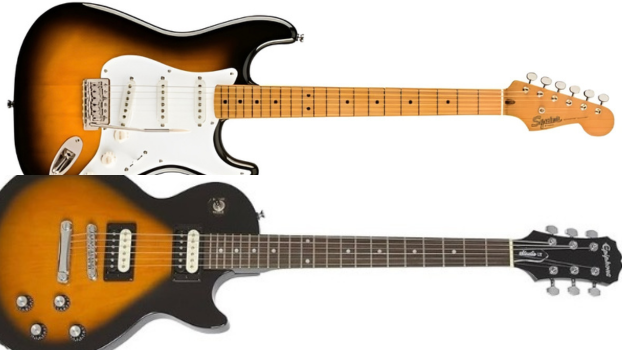
The gap between Squier and Epiphone has narrowed, but the ‘soul’ of these instruments remains worlds apart. One is built for snap, sparkle, and comfort and the other is built for thick, saturated power.
If your brain is thinking of a future where you’re playing heavy riffs and fat power chords, one of these brands is going to feel like home, and the other is going to feel like a compromise. Let’s dig in.
| The Category | The Winner | The Veteran’s Why |
|---|---|---|
| Pure Rock Punch | Epiphone | Humbuckers offer that “thick” wall of sound right out of the box. |
| Beginner Comfort | Squier | Contoured bodies and lighter weight make for easier 2-hour practice sessions. |
| Distortion Quality | Epiphone | Smooth, sustain-heavy gain without the “single-coil hum.” |
| Versatility | Squier (HSS) | If you want to play Funk, Blues, AND Rock, the HSS Strat is the king. |
| The “Rockstar” Feel | Epiphone | That Gibson-style “weight” makes the future-successful you feel more real. |
This is not just Squier vs. Epiphone.
It’s really this:
This matters because beginners do better when the guitar matches the sound they want to hear.
If the guitar sounds wrong for your favorite kind of music, practice feels less rewarding.
| Spec | Squier (Beginner Models) | Epiphone (Beginner Models) |
|---|---|---|
| Pickup Type | Single-Coils or HSS | Dual Humbuckers |
| Scale Length | 25.5″ (Higher Tension) | 24.75″ (Lower Tension) |
| Bridge Type | Tremolo (Whammy Bar) | Fixed (Tune-O-Matic) |
| Body Weight | Lightweight Contoured | Medium to Heavy Solid |
| Best For | Snap, Sparkle, & Indie | Chunk, Sustain, & Hard Rock |
To the untrained eye, it’s just wood and wires. But after many years of feeling these guitars against my ribs, I can tell you that your brain makes changes the moment you strap one on.
⚡️For more info on creating your individual tone, read The Beginner’s Guide to Crafting Your First Pro Rock Tone
Squier gives you the Fender DNA. Think of it as the “Swiss Army Knife” of guitars.
Epiphone gives you the Gibson DNA. This is a specialized tool built for one thing: Authority.
This is where the “Identity of Success” is won or lost. If you want to sound like your heroes, you have to understand pickup technology.
Imagine a high-definition photograph. It’s sharp, detailed, and bright.
But if you blow it up too large (add too much distortion), it can get “grainy” or noisy. That’s the single-coil “hum.”
It’s great for expression, but it can be frustrating for a rock beginner who just wants a clean, heavy “chunk.”
Imagine a thick oil painting. It’s rich, deep, and has “weight.” Humbuckers use two coils to “buck the hum.”
For a rock beginner, this allows you to play with high gain without the annoying buzzing sound, making your practice feel more professional and “record-ready” instantly.
Picking the right guitar is vital, but it’s only one half of the equation. Make sure you check out my Tube Amps vs. Modeling Amps guide to ensure your new axe has the right “engine” to drive your sound.
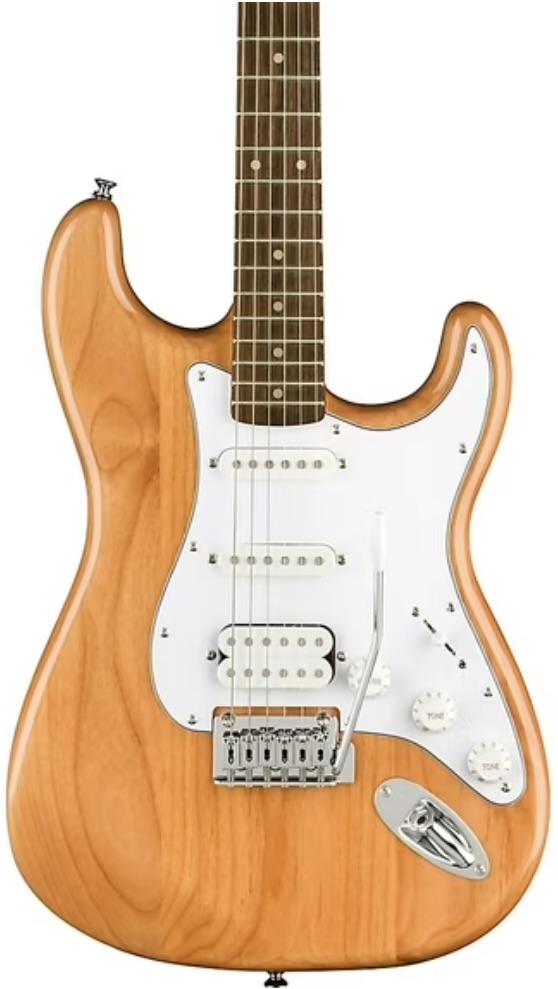
⚡️Pro Tip: If you buy a Squier, ensure it is an HSS model. That “H” stands for Humbucker in the bridge position. It gives you the best of both worlds. The comfort of a Squier with the rock-power of an Epiphone.
Read more about these pickups in my Humbucker vs. Single Coil Review.
After four decades of playing, I’ve learned that the “best” sounding guitar in the world is useless if it’s sitting in its case because it’s too heavy for your shoulder.
Squier is the king of first-day comfort.
Epiphone playability is a different beast. It feels “substantial,” which can be a double-edged sword for a beginner.
Let’s get one thing straight: In 2026, both brands are producing incredible instruments for the price. However, “Budget” guitars still come with “Budget” setups.
A $200 Squier with a professional setup will play circles around a $1,000 Gibson that hasn’t been touched. When you buy your first guitar, your goal isn’t just to buy wood, it’s to buy playability.
After 40 years of hearing these two brands go head-to-head, I’ve realized the answer isn’t about quality, it’s about intent.
Choose a Squier if your “future-successful” self is playing a mix of genres. If you want a guitar that feels light against your ribs and offers a “snappy” response for clean tones, indie rock, or pop-punk, Squier is your home.
Choose an Epiphone if you already know your heart belongs to riff-driven rock. If you want the thick “chunk” of a humbucker and a guitar that feels like a solid piece of history in your lap, Epiphone is the shortcut to that sound.
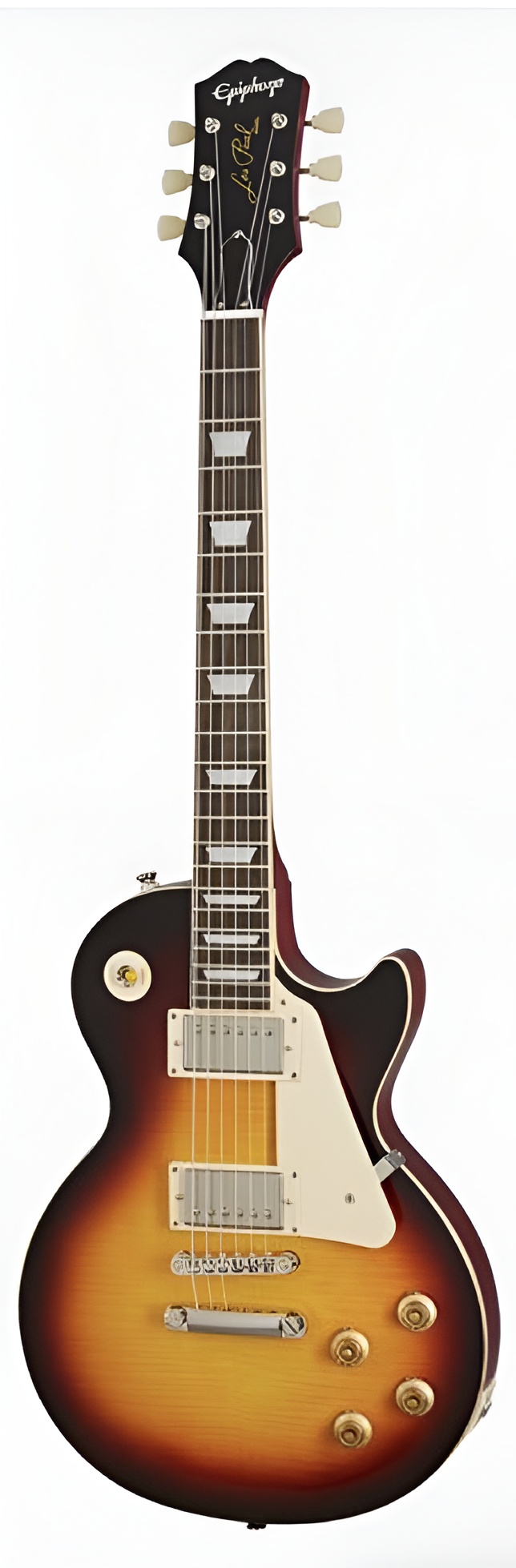
If you’re leaning toward the Epiphone for that thick rock punch, see why I consider it a “dream pairing” in my Epiphone Les Paul Studio E1 review, where I dive deeper into its saturated tone potential.
| Model | New (Amazon) | Pre-Owned (Reverb) |
|---|---|---|
| Squier Affinity HSS Strat | Check Price | See Deals |
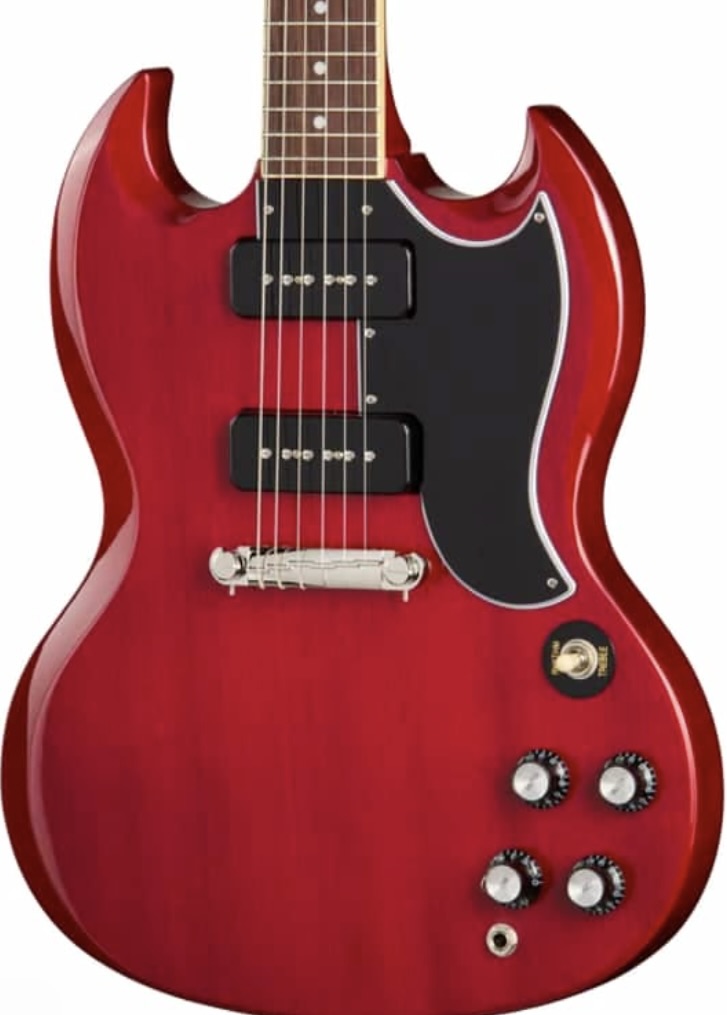
| Epiphone SG Special | Check Price | See Deals |
| Epiphone Les Paul Studio | Check Price | See Deals |
| Squier Pros & Cons | Epiphone Pros & Cons |
|---|---|
Pros:
Cons:
|
Pros:
Cons:
|
| The Category | The Winner | The Veteran’s Score |
|---|---|---|
| Pure Rock Tone (Humbucker Punch) | Epiphone | 9.5 / 10 |
| Body Comfort & Ergonomics | Squier | 9.0 / 10 |
| Sonic Versatility (The “Swiss Army Knife”) | Squier (HSS) | 8.5 / 10 |
| Tuning Stability (Fixed Bridge vs. Tremolo) | Epiphone | 8.0 / 10 |
If your goal is to walk into a room, turn your amp to 11, and feel the floor shake with a massive rock riff, Epiphone gets the nod for most rock-first beginners. It removes the “thin” sound that causes so many beginners to get frustrated with their gear.
However, if you want a lighter, more flexible partner that can handle a clean blues lick just as well as a punk-rock chorus, the Squier HSS Strat remains the smartest “balanced” choice on the market.
After 40 years of chasing tone, I don’t just look at spec sheets. For this comparison, I put both Squier and Epiphone through the String Shock “Real World” Stress Test.
⚡️Pro Insight: This instrument is just one piece of the puzzle. See how I pair these guitars with the right accessories and learning tools in my Ultimate Rock Guitar Starter Kit.
Both are good beginner brands, but the better choice depends on your goal. If you want to play mostly rock, Epiphone usually has the edge. If you want more flexibility and a lighter feel, Squier is often the better pick.
Epiphone is usually better for rock because most models come with humbuckers. Humbuckers give you a thicker, smoother sound with less noise under distortion.
Yes, especially HSS Strat models. They give beginners better rock tone than traditional SSS Strat setups while keeping the comfort and versatility Squier is known for.
Many beginners choose Epiphone because it gives them a more classic rock sound right away. Power chords feel bigger, gain sounds smoother, and humbuckers handle distortion better than most single coils.
If you want comfort, lighter weight, and more tonal range, a Squier Strat is a great first guitar. If you want thicker rock tone and stronger sustain, an Epiphone Les Paul is often the better first choice.
For many beginners, yes. An Epiphone SG often gives you the same humbucker rock sound with a lighter body and easier upper fret access.
Some do. If you want a Squier for rock, look for an HSS Strat or another model with a bridge humbucker. That setup usually works much better for distorted rock tones.
Many Epiphone Les Paul-style guitars are heavier than Squier Strat-style guitars. That said, Epiphone SG models are often lighter and may feel easier for some beginners.
Squier is usually more versatile, especially in HSS Strat form. It covers clean tones, crunchy rhythm, and lighter lead work very well across multiple styles.
For beginners, setup matters a lot. A properly set-up guitar can feel easier to play, stay in tune better, and sound more enjoyable, no matter which brand you choose.

I’ve been playing guitar 40 years now; writing, recording, and rocking in bands. Randy Rhoads, Warren DiMartini, and of course, Jimi Hendrix all lit the fire for me, and I’ve been chasing that passion ever since.


