

How to Tune a Guitar by Ear and Actually Trust What You Hear
40+ Pro Tip: Mastering your ears is how you stop being a “student” and start being a musician.
Today’s modern tuners usually give you a bright green light, but the moment you hit a G major chord, something might be a bit…off.
You did what the screen told you to do. Every string looked right. The tuner said you were in tune.
So why does the chord still sound sour?
Because your tuner doesn’t play the guitar. You do.
A tuner is a great starting point, but your ears are the final judge. The tuner can measure one open string at a time. Your ears hear the whole guitar working together.
That matters when you are recording, playing with other musicians, dealing with old strings, or trying to make open chords sound clean. If the chord sounds wrong, the screen does not get the final vote.
⚡️FREE: The 15-Minute Rock Momentum Routine
Stop fumbling through practice. Get the simple daily routine that keeps your fingers sharp and your playing moving forward, even on your busiest days.

Build Your Total Rock Rig
Key Takeaways
-
Tuners are references, not gods. They get you close; your ears get you home.
-
Trust the “Wobble.” If the note is pulsing, it’s not done. Wait for the stillness.
-
The B-String requires a “nudge.” Expect it to be the one that needs the most ear-based adjustment.
-
Environment dictates your tools. Use the tuner in the bar, use your ears in the studio.
-
Floating bridges require a two-step process. Tune, lock, and then use fine tuners at the bridge.
-
Stretch your strings. Tuning is a mechanical process as much as an auditory one.
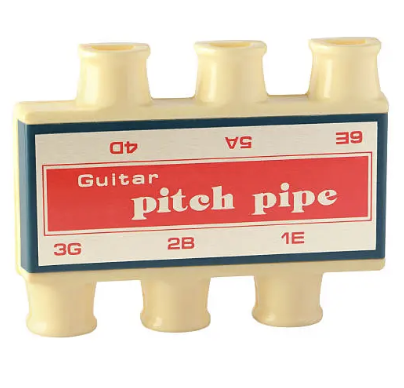
I remember my first tuner. It was a pitch pipe, basically a small harmonica that blew a reference note for each string. No screen, no needle, no green light. Just your ear and the note.
It was frustrating at first. But looking back, it forced me to actually listen. That early habit is probably why I can hear a sour chord across a room today.
The tools got better. The skill stayed the same. -Steve
The “Stillness” of the Note: Hearing the Lock
As beginners, we tend to listen for the note itself. More experienced players listen for the movement around the note.
When two strings are close but not quite matched, you’ll hear a wobble. That sound is called beating. It feels like the note is pulsing, waving, or breathing in and out.
The farther apart the notes are, the faster the beating gets. As you bring the string into pitch, the pulsing slows down.
When the pulsing stops, the sound becomes still. That stillness is where the resonance lives.
Your brain is waiting to hear that resolution. When you finally hit the unison, you may even feel the guitar body vibrate differently against your ribs. It feels like a physical lock that no digital needle can fully show you.
The Harmonic Trick: The 5th and 7th Fret
One of the fastest ways to hear this is with natural harmonics.
- Lightly touch the low E string directly above the 5th fret wire. Do not press down.
- Pluck the string and let the harmonic ring.
- Now lightly touch the A string directly above the 7th fret wire.
- Pluck that harmonic and listen for the wobble.
If they are not matched, the wobble will be obvious. If the wobble is fast, the string is farther out. If it slows down, you are getting closer.
You’re looking for one clear, vibrant chime that sounds like one voice, not two.
If you want to take this further, check out JustinGuitar’s free ear training class. It is one of the best free resources for guitarists who want to sharpen their listening skills, ten minutes a day.
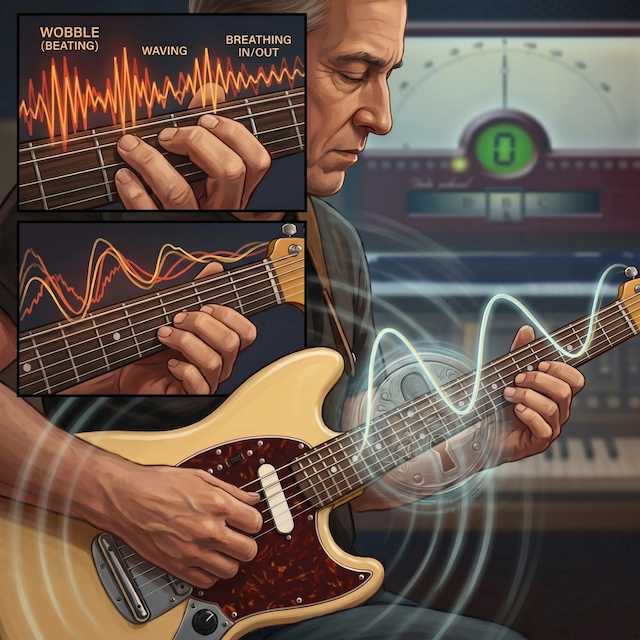
Pro Tip: A little gain or distortion can make the wobble easier to hear, but do not overdo it. Too much distortion can hide the detail.
This method is useful because it removes the finger pressure problem. If you press a fretted note too hard, you can accidentally bend it sharp. Harmonics let you hear the pitch more cleanly.
The B-String Conspiracy: Why One String Rebels
If you’ve ever felt like your B string is a habitual liar, you are not imagining things.
Most neighboring strings on the guitar are tuned in fourths:
- Low E to A
- A to D
- D to G
- B to high E
But the jump from G to B is a major third. That one difference helps make standard guitar tuning useful, but it also creates some tuning headaches.
Because of equal temperament, the system that divides an octave into 12 equal parts, the guitar is always a compromise. It lets you play in every key, but not every interval will sound perfectly pure.
That is why the B string can look perfect on a tuner and still sound a little sour inside certain chords.
The fix is simple. Tune with your tuner first. Then play real chords. If the B string sounds too sharp inside the chord, nudge it slightly flatter by ear.
Do not overdo it. You are not trying to reinvent the tuning system. You are making a tiny adjustment so the guitar sounds better in the song you are actually playing.
Mastering this is one of those small skills that makes you sound more experienced right away.
The “Stretch and Settle” Technique
A major reason beginners struggle to stay in tune is that they do not seat their strings after changing them.
New strings stretch. They slip around the tuning post. They settle into the nut, bridge, and saddles.
This is especially important on starter guitars, like the one I covered in my Squier Debut Telecaster review, where setup and string stability can make a big difference.
If you skip this step, you can tune perfectly and still go flat five minutes later.
- Tune to pitch.
- The tug: Place your fingers under the string around the 12th fret and pull it gently but firmly away from the fretboard.
- The drop: The pitch will usually fall after you tug the string.
- The resolve: Tune back up into the note.
Repeat this until the pitch stops dropping.
Always tune up into the note, not down into it. If you overshoot and go sharp, drop below the pitch and come back up again. This helps remove slack from the tuning post and keeps the string more stable.
If you skip this step, you’ll be chasing your tail with the 5th fret method for twenty minutes.
This is the process I talk about in the How To Tune A Guitar For Beginners post.
The Reality Check: When Your Ears Fail
Let’s be real. Ear tuning has limits.
In a noisy bar, your ears are not enough. A stable guitar makes this easier, which is one reason I pay close attention to tuning stability in reviews like my PRS SE Studio review.
When the drummer is hammering through sound check and the room is shaking, you need your tuner. It is your anchor in the chaos.
If you are a rock guitarist playing a floating bridge, like a Floyd Rose, you are also playing a different tuning game. Because the bridge floats on spring tension, changing one string affects the others.
The floating bridge workflow:
- Tune normally with the locking nut open.
- Check all strings again. One pass is almost never enough on a floating bridge.
- Lock it down: Tighten the locking nut at the headstock.
- Fine-tune: Use the small fine tuner knobs at the bridge to bring each string home.
Once the nut is locked, your headstock tuners are out of the equation. Use the bridge fine tuners from there.
Guitar Intonation: Why Your Setup Might Be the Real Villain
If your open strings are in tune but chords higher up the neck sound like a train wreck, your intonation may be off.
Intonation is the guitar’s ability to play in tune as you move up the fretboard. Your open string can be perfect, but the 12th fret note can still be sharp or flat if the bridge saddle is not in the right place.
That means your guitar may not agree with itself.
A quick check is simple. Tune the open string. Then play the same string at the 12th fret. If the 12th fret note is sharp or flat, the saddle position may need adjustment.
No amount of ear training can fix a mechanical setup problem. Sometimes the smartest move is to stop blaming your ear and check the guitar.
If you are still fighting a cheap or poorly set-up starter guitar, it may also be worth comparing it against my guide to the best beginner electric guitar.
Read more on Guitar Intonation 101 from the experts at Fender.
The Slow Strum: Using Your “Lie Detector” Chords
Once the math of the tuning is done, you need a final reality check. I never fully trust my tuning until I run it through a slow-motion lie detector test.
Play an open G major, E major, or D major chord. Do not just strum it once and move on. Pick through the chord slowly from the lowest string to the highest string. Let each note ring into the next.
- The G major test: If the B string sounds sour against the open G or high E, you will hear the chord wobble instead of bloom.
- The E major test: If the G# on the first fret of the G string is fighting the open B or high E, you will hear the tension immediately.
- The D major test: If the fretted notes sound sharp, check your finger pressure before blaming the tuner.
The goal is for the chord to bloom. It should open up and ring as one sound, not feel like six strings arguing with each other.
Over time, your brain builds a clear memory of what a good open chord should sound like. Once that sound is locked in, any string that is out of tune will feel like a physical itch you need to fix.
Final Verdict: Building the Rockstar Brain

Most beginners think tuning is something you finish before you start playing.
That is the wrong mindset.
Tuning is playing. It is the first moment you connect with the instrument and make a musical decision.
When you train your ears to hear the difference between almost right and locked in, you stop guessing. You start taking control of your sound.
After decades of playing and recording, I have learned that the most important tool in my gig bag is not the most expensive tuner. It is the ability to hear when something is off and know how to fix it.
Use the tuner. Trust the tuner when the room is loud. But don’t become dependant on the screen.
When you use your ears, tuning stops being a chore and starts becoming part of your playing.
Be in tune. Be in control.
Frequently Asked Questions
1. Is tuning by ear more accurate than an electronic tuner?
Tuners are mathematically perfect, but ears handle musical reality. A veteran uses their ear to find the “sweet spot” within a chord that a digital needle often misses due to the guitar’s inherent physical compromises.
2. How long does it take to learn to tune a guitar by ear?
It’s a habit, not a talent. Practice the 5th-fret method for two minutes a day, and your brain will start locking into the “unison” sound within two to four weeks.
3. Can you tune a guitar by ear without any reference note?
You can tune a guitar to itself, but you won’t be in “concert pitch.” Without one anchor note (like a tuner, piano, or tuning fork), you will clash with recordings and other band members.
4. Why does my guitar sound out of tune even after I’ve tuned it?
It’s likely a hardware failure. If your intonation is off at the bridge or your strings are sticking in the nut slots, the instrument will sound “sour” even if the open strings are perfectly in tune.
5. What is the difference between the 5th fret and harmonic methods?
The 5th-fret method is easier for beginners but can be “sharped” by heavy finger pressure. The harmonic method uses pure physics to create a chime that provides a more clinical, stage-ready lock.