

How to Make Guitar Solos Sound Less Robotic
You can play the right notes and still have a solo sound flat, stiff, and kind of boring.
That’s what happens when every note gets the same pick attack, the same length, and no movement.
The good news is you don’t need a pile of new scales to fix it.
You can take the same handful of notes you already know and make them sound way more human with a few gritty lead-guitar moves.
Key Takeaways
- The notes aren’t the problem. A pentatonic run sounds robotic because every note gets the same pick attack, the same length, and zero movement.
- Vibrato is the biggest single upgrade. Anchor your thumb on the back of the neck and shake the string. Tight and fast, or wide and nasty. Just don’t let held notes sit frozen.
- Rake into notes for grit. Mute the nearby strings with your fretting hand, brush across them, and land on the target note. That scrape gives the note attitude before it rings.
- Bends and pre-bends change how a note arrives. A bend moves the pitch after you hit it. A pre-bend puts you at the bent pitch the second the note sounds. Stack vibrato on top of either one.
- Slides connect what picking separates. Full slides, backward slides out of a note, and fast grace-note slides all break up the picked-note-picked-note pattern.
- Mix long and short. Clip a note with staccato, let the next one ring, and use hammer-ons and pull-offs to link notes without re-picking.
- Don’t glue a trick onto every note. Pick one or two moves per phrase. The goal is contrast, not decoration.
⚡️FREE: The 15-Minute Rock Guitar Practice Routine
Stop “practicing” and start playing. Grab the daily blueprint I use to keep my fingers stage-ready in just 15 minutes.
Stop Treating Every Note the Same
When we first start playing lead, we’re trying to get through the notes without making total garbage sounds. I get it.
You learn a pentatonic pattern, pick every note cleanly, and try not to screw it up.
But that first version is usually robotic because every note comes out the same way.
The notes are only part of the solo. How you hit, hold, bend, and leave those notes matters just as much.
We’re talking about the same basic group of notes here. Five, six, whatever, I didn’t count.
The point is that a plain pentatonic run can sound completely different once you start scraping into notes, bending them, sliding around, and shaking some life into the held notes.
Keep the pentatonic scale, change the delivery
Don’t throw out the pentatonic scale. That scale is rock guitar ground zero.
The problem isn’t the notes. The problem is running up and down the shape like you’re checking boxes.
Instead of picking every note in the same hard, even way, start mixing in:
- Rakes before a target note
- Vibrato on notes that hang in the air
- Regular bends and pre-bends
- Full slides and quick grace-note slides
- Short, clipped staccato notes
- Hammer-ons and pull-offs
If you need a refresher on getting those familiar shapes into a rock solo, my rock guitar solo guide keeps the focus where it belongs, on making music instead of getting buried in theory.
Rake Into a Note for Some Grit
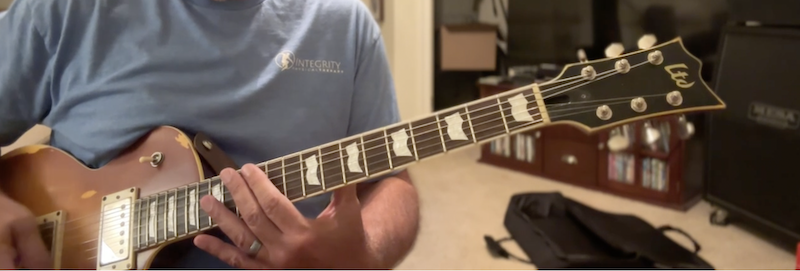
Raking is one of my favorite little tricks. I don’t know why, I just think it sounds cool.
Instead of picking one note all by itself, mute the nearby strings with your fretting hand and brush the pick across them on the way to your target note.
Those muted string sounds give the note some attitude before it even rings out.
Let the muted strings lead into the target note
A rake can happen in different spots, but I usually rake from the nearby strings right into the note I want.
You’re not trying to make the muted strings ring clearly. You’re using them as a quick scrape that launches into the real note.
Try this move:
- Pick a note by itself.
- Then mute the nearby strings with your fretting hand.
- Brush across them and land on that same note.
That tiny bit of noise breaks up the clean, mechanical sound.
After the rake lands, add some vibrato and the note starts to feel like it has somewhere to go.
A rake lives or dies on your amp, too. On a clean setting those muted strings just sound like a mistake.
Push some gain into it and that same scrape turns into grit. If you’re still figuring out how much drive you have to work with, my Boss Katana 50 vs Fender Mustang LT50 comparison breaks down how each one handles dirty lead tones.
Make Held Notes Move With Vibrato
If I had to pick one thing that matters a ton for lead playing, it’s vibrato.
A note that sits there dead still can sound lifeless, even if you nailed the pitch.
Vibrato is the shake you add after the note is fretted.
It can be small and tight, or it can be wide and nasty. Both work. It’s about how much movement you want to hear.
Start small, then widen it up
Anchor your thumb on the back of the neck. That gives your hand something solid to work against while you move the string.
I might use a little minimal shake for one note, then go much wider on another.
There isn’t one magic width. Play with it. Feel how the string moves under your finger.
You can add vibrato after a plain note, after a bend, or on top of a pre-bend.
The key is that the note isn’t frozen in place.
Bend and Pre-Bend Instead of Playing It Straight
A bend changes the pitch after you hit the note.
That alone pulls a phrase away from the robotic sound of picked note, picked note, picked note.
Then you can add vibrato at the top of the bend. That’s a great way to make one note carry more weight than the notes around it.
Heads up, though. Heavy bending punishes a guitar that won’t hold tune.
If you’re pushing a full step and the next chord sounds sour, that’s the instrument talking, not your hands. I covered how two popular starters hold up under that kind of abuse in my Yamaha Pacifica 112V vs Ibanez GIO GRG220PA1 comparison.
Pre-bends change the entrance
A pre-bend is different because you bend the string first, then pick it.
You’re not hearing the pitch rise up from the original note. You’re already at the bent pitch when the note hits.
That gives you another way to enter a note without sounding so predictable. Mix a pre-bend with vibrato, or rake into the note first and then let it shake.
For a closer look at these moves, including how bends and slides can work together, check out my guide to expressive guitar bends and slides.
Slide Into Notes Instead of Picking Them All
A slide connects notes. It keeps you from attacking everything the same way with the pick.
You can play a full slide where one note clearly moves into the next.
You can also slide backward out of a note.
Both sounds are useful, and they create different little bits of motion inside the phrase.
Use a quick grace-note slide
The quick grace-note slide is a cool one.
Pick the first note, but don’t let it sit there like a full note. Slide into the next fret so fast that the target note is what you really hear.
For example, on the G string, pick around the 12th fret and slide fast into the 14th fret. The 12th-fret note is there, but it flashes by. The 14th fret is where the phrase lands.
You can also reverse that idea and slide backward.
That little slide away from a note creates its own effect, especially when you’re trying to keep a phrase from sounding too square.
Break Up the Phrase With Staccato and Legato
Not every note needs to ring for the same amount of time.
Staccato gives you short, clipped notes that cut off fast.
Put one of those between longer notes, bends, or slides and the rhythm of the phrase changes right away.
Let some notes breathe. Choke others off.
Hammer-ons and pull-offs smooth out the attack
Hammer-ons and pull-offs are another way to stop picking every note with the same attack.
With a hammer-on, you pick a note and hammer your fretting finger onto a higher fret.
With a pull-off, you move from a higher note down to a lower one without re-picking that lower note.
Those moves let the notes flow together differently than a fully picked line.
Slides, hammer-ons, and pull-offs can all live inside the same pentatonic phrase.
If the picked notes feel choppy, my breakdown of hammer-ons and pull-offs for legato gets further into that smoother side of lead playing.
Mix the Techniques Into the Same Notes
This is where things get fun.
You don’t need to map out every move like a science project.
Start with the notes you know, then throw in a technique where it feels good.
You might rake into a note and hit it with vibrato.
You might bend a note, hold it, and add vibrato on top.
Maybe you use a pre-bend, a fast grace-note slide, then a few hammer-ons and pull-offs.
Here are a few combinations that work with the ideas above:
- Rake into a target note, then give it vibrato.
- Bend a note and shake it at the top.
- Hit a pre-bend and let it wobble.
- Pick a quick grace note and slide into the next fret.
- Slide backward out of a note instead of ending it dead.
- Clip one note short with staccato, then let the next one ring.
- Use hammer-ons and pull-offs to connect notes between picked attacks.
Don’t feel like every note needs some fancy move glued onto it.
That’s not the point.
The point is to stop treating the whole phrase like every note has the exact same job.
Let the Same Notes Sound Like Music
A pentatonic scale played straight can sound robotic.
Add a rake, a bend, a pre-bend, vibrato, slides, staccato, hammer-ons, and pull-offs, and those same notes start sounding like a guitar solo instead of a scale exercise.
I keep coming back to vibrato and raking because they add so much with so little.
But mix all of it up.
A few rough edges, a quick slide, and some movement in a held note can turn a plain phrase into something way more interesting to hear.
Frequently Asked Questions
1. Why do my solos sound robotic even when I’m hitting the right notes?
Because every note gets the same attack, length, and pitch. Your ear hears a pattern, not a phrase. Change how two or three notes start and stop, and the run loosens up fast.
2. Do I need to learn more scales to fix this?
No. More scales give you more notes, not more expression. Five pentatonic notes played with bends, rakes, and vibrato beat a whole mode played flat.
3. What’s the difference between a bend and a pre-bend?
A bend rises after you pick it. A pre-bend is already bent when the pick hits, so nobody hears the climb. Use pre-bends when your normal bends start sounding predictable.
4. How wide should my vibrato be?
There’s no set width. Tight and quick suits fast passing notes. Wide and slow suits notes left hanging. What matters is that your hand drives the shake, not the string.
5. My rakes just sound like noise. What am I doing wrong?
You’re not muting enough. Lay your fretting hand across the lower strings so they thud instead of ring. A rake is percussion, not pitch.
6. How fast should a grace-note slide be?
Fast enough that the first note flashes by. Pick the 12th fret on the G string and shove into the 14th almost instantly. If someone can hum that first note back, you’re too slow.
7. How many techniques should I use in one phrase?
One or two. Rake into a note and shake it, or bend, hold, and add vibrato. A trick on every note is just as flat as playing straight, only busier.
8. How long before this stops feeling forced?
Two weeks of short daily reps on one lick. Play the same four notes six ways: straight, raked, bent, pre-bent, sliding in, clipped short. Your hands start grabbing the moves on their own.