
Why Every Guitar Mistake You Make Is Actually Moving You Forward
Whoa! You just butchered that riff for the fifteenth time.
Your fingers went to the wrong fret, you rushed the transition, and now you’re sitting there wondering if you’re just not cut out for this.
You’re thinking, “maybe guitar is for other people, maybe I’ve already plateaued, maybe I should just put the thing back on the stand and call it a night.”
STOP right there my friend!
What just happened; that mistake, that frustration, that ugly sound, isn’t evidence that you’re failing. It’s evidence that you’re learning.
And I don’t mean that in a motivational poster kind of way. I mean it literally, physiologically, in terms of what your brain is physically doing right now.
I’ve been playing guitar for 41 years. Self-taught. No formal lessons, no music school, just a whole lot of trial and error and a love for the instrument that started before I even picked one up.
And the single most important thing I’ve learned in four decades isn’t a technique, a scale, or a chord progression. It’s this:
“Making mistakes is how you learn, so don’t punish yourself every time you make one.”
— String Shock Steve
Let me tell you why that’s true, what’s actually happening inside your head when you mess up, and how to turn your mistakes from enemies into the most powerful practice tool you have.
The Real Reason Most Guitarists Quit (It’s Not What You Think)
Ask most people who gave up on guitar why they quit and you’ll hear the same handful of answers. I didn’t have time. I wasn’t talented enough. My fingers just wouldn’t cooperate. It was too hard.
Those aren’t the real reasons.
The real reason is that nobody told them the frustration was supposed to be there.
Nobody told them that struggling, messing up, and feeling stuck isn’t a warning sign, it’s just what progress looks and feels like from the inside.
So they interpreted the difficulty as failure and walked away from something they actually loved.
Here’s the loop that takes down more guitarists than any barre chord ever has:
- You make a mistake
- You get frustrated and beat yourself up
- Practice starts to feel miserable
- You practice less
- You get worse, or stop improving
- You decide you’re just not a “guitar person”
- The guitar goes in the closet
Sound familiar?
It should.
I’ve seen it happen to countless players over the years, and if I’m being honest, I’ve felt the pull of that loop myself when I first started.
The difference between the guitarists who make it and the ones who don’t usually has nothing to do with talent. It has everything to do with whether they understood what their mistakes were actually telling them.
⚡️Read more on the psychology of the rockstar in the String Shock Method.
What’s Actually Happening in Your Brain When You Make a Mistake
Here’s where it gets interesting, and I promise I’m not going to turn this into a neuroscience lecture.
But, (If you want the full deep dive on how your brain builds a practice habit, I wrote about it over at The Neuroscience Hack to Build a Daily Guitar Routine.)
There are 3 things worth knowing about what happens upstairs when you mess up a riff.
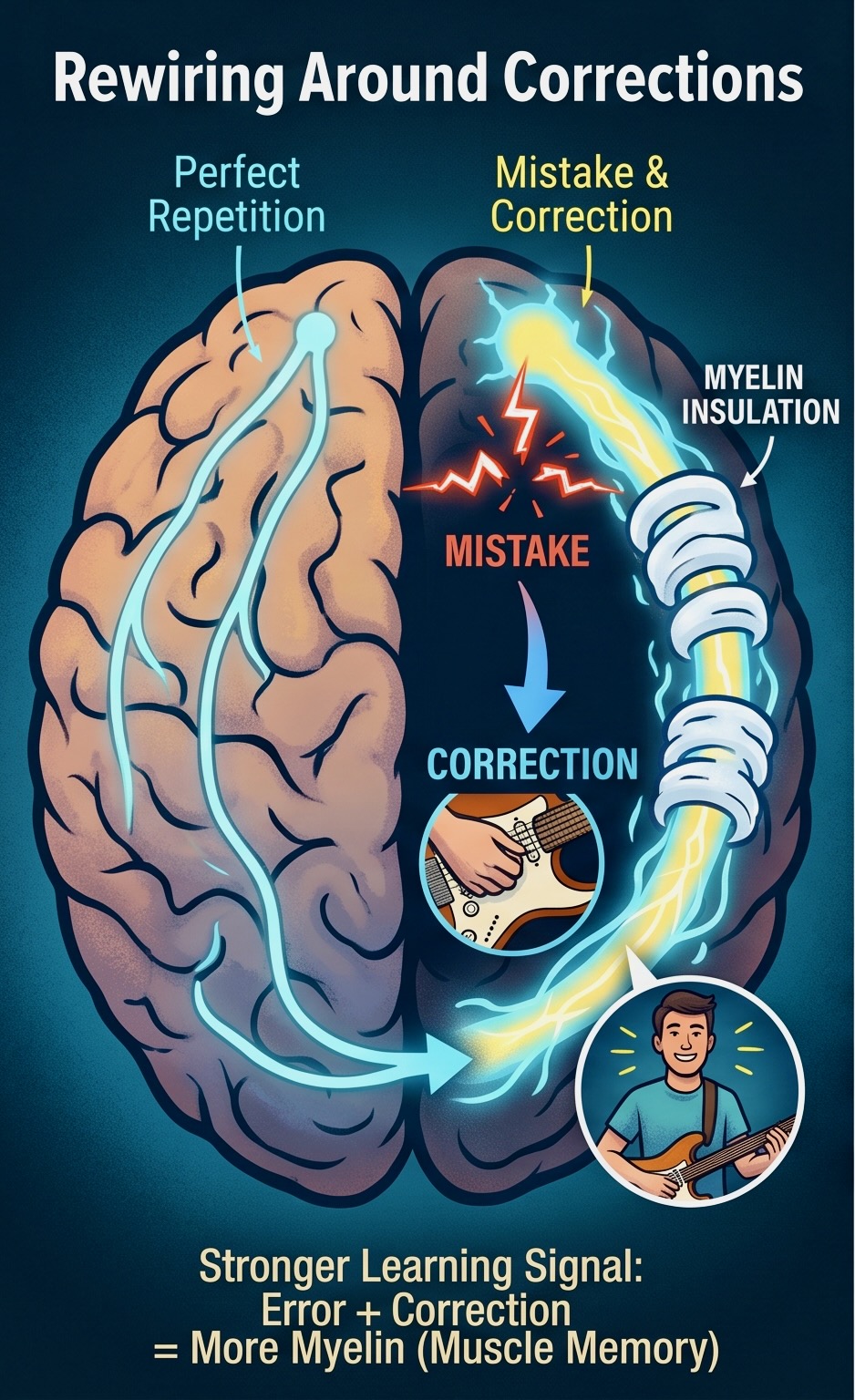
1. Your Brain Literally Rewires Around Corrections
Every time you repeat a physical motion, like a guitar technique, your brain wraps the neural pathway responsible for that motion in a fatty insulating layer called myelin.
The more myelin, the faster and cleaner the signal travels. That’s what muscle memory actually is: myelinated pathways firing efficiently.
Here’s the part most people don’t know: the mistake-and-correction cycle is more effective at building myelin than flawless repetition.
When you make an error, identify it, and then execute the correction, your brain fires a stronger learning signal than when you just run something perfectly ten times in a row.
The struggle is literally doing the wiring work.
2. Difficulty Means the Information Is Sticking
Cognitive scientists call it “desirable difficulty”, the idea that learning feels harder precisely when it’s working best.
When practice feels easy and comfortable, you’re probably just reinforcing what you already know.
When it feels like a grind, like your fingers are fighting you, like you can’t quite get it, that’s the feeling of new neural connections being formed.
Easy practice feels great. Hard practice is great.
3. Self-Criticism Physically Blocks Learning
This one matters a lot.
When you beat yourself up after a mistake, when you go into “I’m terrible, I’ll never get this, why do I even bother” mode, your brain shifts into a threat response.
Cortisol goes up. Your prefrontal cortex, the part responsible for learning and problem-solving, starts taking a back seat to your fight-or-flight system.
In plain English: you literally cannot absorb new information as well when you’re stressed and self-critical.
The punishment isn’t just unpleasant. It’s counterproductive at a biological level.
Pro Tip: Slow, deliberate practice with mistakes is worth 10x more than fast, sloppy run-throughs where you’re just hoping it comes out right. Speed is earned, not assumed.
String Shock Steve’s Story

There was no internet when I started playing guitar. I learned through many different ways including books, magazines, listening to music, and the local guitar hero in the neighborhood.
Making mistakes was easy, right?
I couldn’t look up any Youtube tutorials, Instagram reels, or TikTok videos.
So, I used to get upset with myself when hitting a wrong note or destroying a chord. I asked all the questions that you’d expect from a noob.
“Why can’t I get it right?”…”Do I have enough talent?”…”Why am I not improving?”
My advice from 41 years experience: STOP SPEAKING NEGATIVE ABOUT YOURSELF!
This will only hinder your progress. You don’t need that bad energy in your life.
The thing I found most useful over the years was to keep going. Keep pushing through the mistakes, no matter what.
For example: the first time learning a riff or song, I always say “let’s get this trainwreck over with.” Meaning that it IS going to sound horrible. Believe me when I say, it WILL sound like a disaster.
But keep playing and it will smooth out over time, I promise you.
Another thing I used to do was to turn the amp up and just play freestyle! Whatever pops into your head, just do it man.
Record these sessions and listen to them. You will hear a ton of garbage but you will also find little treasures too. This is how you get better. Pick out those little golden nuggets and store them in your mind.
Doing this forces you to weed out the bad from the good. This will definitely make you a better player in the long run.
Experimenting with techniques, tones, and a variety of alternative note choices will create in you a more expressive player.
All that will hear you will be absolutely enlightened.
So go ahead and start making those mistakes and listen how better you’ll sound over the next 3, 6, 9 months.
Read more about me and my story here.
-Steve
⚡️FREE: The 15-Minute Rock Guitar Practice Routine
Stop “practicing” and start playing. Grab the daily blueprint I use to keep my fingers stage-ready in just 15 minutes.
The Comparison Trap: A Special Kind of Self-Punishment
Mistakes you make alone in your practice room are one thing.
But there’s another kind of self-punishment that’s gotten a whole lot worse in the YouTube era, and it’s worth calling out directly.
Comparing yourself to players who’ve been at it for decades.
You’re ten days into learning guitar. You pull up a video of some guy shredding through a Metallica solo and think, I’ll never sound like that.
Of course you won’t. Not today.
That guy has probably been playing since before you were thinking about picking up a guitar. You’re comparing your day one to his year fifteen.
That’s not a fair fight, and it’s not useful information.
⚡️Read more about Why Comparison Kills Your Progress as a Guitarist here.
Here’s what Hendrix, SRV, and Clapton all had in common besides the fact that they became legends.
They all sucked before they were great. They all hit walls.
They all played things wrong, developed bad habits, and had to unlearn things.
The difference is they didn’t have social media showing them a highlight reel of every other guitarist’s best moments while they were grinding through their worst ones.
The only comparison that means anything is YOU versus YOU last month. That’s it.
- Is your bend more in tune than it was 30 days ago?
- Can you switch between chords a little faster?
- Do you sound more like yourself than you did at the beginning? (That’s the scoreboard that matters)
How to Actually Use Your Mistakes (A Simple 3-Step Framework)
Philosophy is great, but you still need something to do with all this when you’re sitting in front of your guitar and your fingers won’t cooperate.
Here’s the framework I come back to every time I hit a wall:
Step 1: Identify, Don’t Ignore
When you make a mistake, stop.
Don’t barrel through and hope it gets better.
Name the problem out loud if you have to. “I’m rushing the transition from the G to the D.” “My pick is catching on the third string.”
Vague frustration is useless. A specific diagnosis is something you can fix.
Step 2: Isolate and Slow Down
Don’t run the whole song again.
Pull out the exact problem spot.
The two-bar phrase, the single chord transition, the specific picking motion, and then work it at half speed.
Your goal isn’t to play it fast. Your goal is to play it right, slowly enough that your brain can actually register the correct motion and start building those pathways.
Once you can nail it slowly five times in a row, gradually bring the tempo up.
Step 3: Use Rep Count, Not Clock Time
“I’ll practice for 20 minutes” is a weak commitment. Twenty minutes of frustrated noodling gets you nowhere.
Instead, set a rep count: I’ll nail this transition cleanly 5 times in a row before I move on. It’s concrete.
You know when you’ve succeeded. And that small win of five clean reps gives your brain the reward signal it needs to lock the learning in.
Pro Tip: If you can’t play it slow, you can’t play it fast. Tempo is a reward for getting it right, not a starting point.
💡One exception is when you start using the “chunking” technique for super fast tempos. In this case, you play groups of 4-5 notes really fast then stop and repeat. This teaches left hand/right hand coordination at fast tempos. For the sake of staying on topic, I’ll cover this in another post.
The Mindset Shift: From Performer to Student

Here’s something I’ve noticed about guitarists who plateau early versus guitarists who keep improving for decades. It almost always comes down to how they think about practice.
Performers want practice to sound good. Every session is a mini audition.
They play through their best stuff, avoid the hard parts, and walk away feeling okay about themselves, but not really better than they were last week.
Students want practice to teach them something.
Every session is an experiment.
They go straight for the hard parts, make a bunch of noise, mess up a lot, and walk away a little better than they were before. That do-it-anyway attitude is exactly where guitar confidence comes from, not from another tutorial.
The shift from “I need to sound good right now” to “I’m figuring this out” is one of the most powerful things you can do for your playing.
It takes the pressure off.
It makes the mistakes okay.
It turns every ugly run-through into data instead of evidence against yourself.
And it all comes back to the same idea: making mistakes is how you learn, so don’t punish yourself every time you make one.
That’s not just a feel-good quote. It’s the entire model. Mistakes are the mechanism. The frustration is the process. The struggle is what progress feels like from the inside.
Final Thoughts: Rack Up the Reps
The guitarists who make it aren’t the ones with the most natural talent.
They’re the ones who kept showing up after they messed up.
They’re the ones who figured out, maybe through a teacher, through sheer stubbornness, or by reading some guy’s guitar blog at midnight, that the hard part isn’t a detour from the journey.
It is the journey.
Every mistake is a rep.
Every correction is a rep.
Every ugly, fumbling, nothing-sounds-right practice session is moving you forward in ways you can’t always hear yet but your brain is absolutely tracking.
So pick the guitar back up.
Play the hard part again.
Make the mistake, name it, fix it, move on.
And for the love of Hendrix, stop punishing yourself for being exactly where you’re supposed to be.
You’re learning. That’s the whole point.
If you want to understand more about how your brain builds guitar skills from the ground up, check out The Neuroscience Hack to Build a Daily Guitar Routine, it goes deeper on the science side and gives you a practical system for making practice stick.
Frequently Asked Questions
1. Is it normal to make a lot of mistakes when learning guitar?
Completely normal, and more than that, it’s necessary. Mistakes followed by corrections are the primary mechanism by which your brain builds new motor skills. If you’re not making mistakes, you’re probably not pushing yourself hard enough to improve.
2. How do I stop getting frustrated when I keep messing up the same part?
First, isolate the specific problem spot, don’t keep running the whole song. Then slow it way down, below the tempo where you make the mistake.
Work it at that slower speed until you can nail it cleanly five times in a row. Then gradually increase the tempo. Frustration usually comes from trying to fix a problem at the speed that’s causing it.
3. Am I too old to learn guitar?
No. Adult brains are absolutely capable of learning guitar, and in some ways, adult learners have advantages over kids. Better focus, more patience, and a clearer sense of what they actually want to play.
The learning process is the same at any age. It just requires consistent practice and not giving up when it gets hard.
4. How long does it take to get good at guitar?
“Good” is relative, but most consistent players start sounding like themselves within 6–12 months of regular practice. The key word is consistent. 20 minutes every day beats two hours once a week.
Don’t chase a timeline. Chase the reps.
How Long Does It Take the Average Person to Learn Guitar?
⚡️Honestly though, if you have a strong desire to learn, you will always find more than 20 minutes a day to practice.
5. What should I do when I feel like quitting guitar?
Put the guitar down for the day but not forever. Take a walk, come back tomorrow.
The urge to quit usually peaks right before a breakthrough, because that’s when the learning is hardest.
If you’ve been feeling stuck for weeks, try changing what you’re practicing rather than how much.
Play something you actually love, even if it’s easier than what you’ve been working on. Reconnecting with the fun is sometimes more productive than grinding through a hard exercise.