Guitar Modes in the Real World: Simple Explanation for Easy Understanding
My 41-Year Take: “If you’ve ever stared at a music theory book trying to memorize seven different modal shapes and felt like throwing your guitar through a wall, you’re not alone. Most of that academic jargon is pure gatekeeping. You don’t need a music degree to play with soul, you just need to realize that your rhythm section holds the remote control to your scale shapes.”
⚡️FREE: The 15-Minute Rock Guitar Practice Routine
Stop “practicing” and start playing. Grab the daily blueprint I use to keep my fingers stage-ready in just 15 minutes.
The Bedroom Trap vs. The Live Room Reality
You sit down in your room, flip on the amp, and run your fingers through the patterns you’ve known for years.
You practice your C Major scale from C to C. Then you move up the neck and run it from F to F because a guitar magazine told you that’s “F Lydian.” You play it by yourself, but it just sounds like… well, a C Major scale starting on a different note.
That right there is the exact point where most lead guitarists give up on modes. It feels like a dry math equation instead of the pure joy of creating expressive, soaring solos.
Here is the raw truth: a scale cannot be modal without a context to fight against.
You can run those F-to-F shapes until your fingers bleed, but if there isn’t a heavy bass note or a driving rhythm pattern anchoring the room, your brain will always pull that sound back to the safe, happy baseline of C Major.
The secret to unlocking the true potential of your fretboard isn’t learning fifty new finger patterns.
It’s understanding that the moment you step into a jam session or turn on a backing track, your fingers no longer dictate the starting line.
The rhythm section does.
The “Same Notes, New Boss” Reality Check
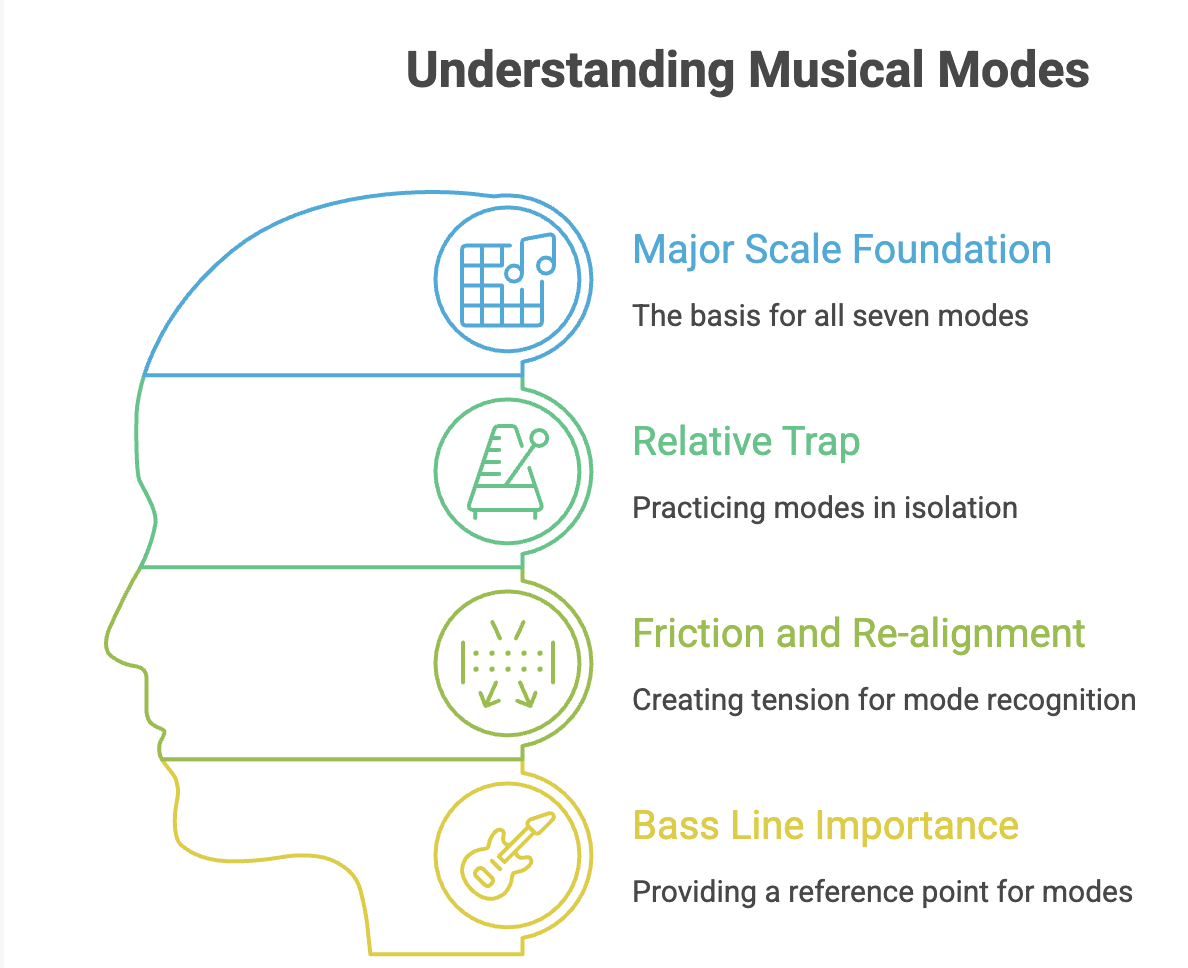
If you can play a standard major scale, you already know all seven modes. You don’t need to reinvent the wheel, and you definitely don’t need to memorize a completely new set of finger positions.
The raw ingredients never change; what changes is who is the “Boss” of those notes once they hit the air.
The Relative Trap
The biggest mistake players make is practicing modes in a vacuum.
Running a scale from F to F by yourself doesn’t make it sound like Lydian; it just sounds like a C Major scale with an awkward starting point. Your ear is naturally lazy and without a bass line to fight against, it defaults to the simplest, most familiar major key home base.
To make a mode speak, you need friction. You need a rhythmic floor that forces those exact same notes to re-align their musical distances in real time.
The Rhythm Section Rules
Think of your scale notes like raw timber. The rhythm section decides if you’re building a bright country church or a smoky, late-night blues club.
Take the key of C Major (C – D – E – F – G – A – B). If the bass player is hammering on a low C, your ears hear total resolution, think pure, happy pop/rock.
But if the bass player suddenly switches to a heavy D chug, and you play those exact same notes, the entire geometric grid changes:
- The F note is no longer just a fourth interval, it becomes a minor 3rd relative to D.
- The B note ceases to be a sweet major 7th, it becomes a sharp, soulful Major 6th relative to D.
Without moving a single finger to a new shape on the neck, the emotional frequency in the room instantly flips from a bright morning anthem to a gritty, Santana-style minor groove.
You are playing your trusted C Major shapes, but you are forcing them to bow to D as the king.
The Power Chord Blank Canvas: A Lead Player’s Ultimate Secret Weapon
When you step out front to rip a solo in a hard rock or heavy metal track, you aren’t fighting against complex jazz chords or delicate piano arrangements.
Most of the time, the rhythm guitarist is locking down the low end with nothing but raw power chords.
And that is where your real power lives.
No 3rds, No Rules
A standard chord needs three notes to define its flavor: a Root, a 5th, and a 3rd. It’s that 3rd note that explicitly dictates whether a chord is Major (happy) or Minor (sad).
But a power chord, like a D5, strips all of that away. It uses only the Root (D) and the 5th (A).
Because the 3rd is completely missing, a power chord is an absolute blank canvas. It is completely ambiguous.
It’s a heavy, driving pulse with zero emotional bias, waiting for you to step up and tell the crowd how to feel.
By choosing which scale family to run over that power chord, you single-handedly dictate the emotional frequency in the room.
One Riff, Three Realities
Imagine the rhythm section is locked into a driving, heavy D5 chug. Because they aren’t forcing a major or minor vibe on you, you can run your trusted scale shapes to paint three completely different sonic pictures:
- The Classic Heavy Metal Vibe (D Aeolian): Pull out your trusted F Major / D Minor scale shapes. By supplying the minor 3rd (F) and the flat 6th (B flat) over this D chug, you instantly forge that brooding, classic metal majesty heard in Iron Maiden or Judas Priest.
- The Soulful, Gritty Rock Vibe (D Dorian): Stay right on that D5 chug, but switch your mind to your C Major / A Minor shapes. You’re still playing that minor 3rd (F), but by sliding that B flat up to a natural B, you inject a high-octane rock grit. The rhythm didn’t change, but your solo just lifted the entire room.
- The Aggressive, Sinister Growl (D Phrygian): Want to turn things dark and threatening? Shift your focus to your B flat Major / G Minor shapes. Slamming that E flat (flat 2nd) right against their heavy D5 foundation creates immediate friction. It screams thrashy, exotic metal aggression like Metallica or Slayer.
If you’re looking for a guitar that covers all tonal possibilities for shredding, read my PRS SE Studio Standard Review.
The Real-World Rock Mode Matrix
The table below breaks down the three essential rock modes you need to know, their hidden “flavor notes,” and how they actually translate to the gear and vibes you hear on classic records.
| Exact Mode Name | The Raw Shape (In C) | The Flavor Note | The Real-World Vibe |
|---|---|---|---|
| D Dorian “The Soulful Rock Minor” |
Play C Major shapes over a D anchor |
Natural 6th (B) | Smoky jazz-rock, high-octane classic blues solos (Santana/Pink Floyd). Adds a lift of hope to a dark minor key. |
| G Mixolydian “The Classic Rock Swagger” |
Play C Major shapes over a G anchor |
Flat 7th (F) | Southern rock, greasy blues, AC/DC-style driving rhythms. It is a major sound, but injected with raw attitude. |
| E Phrygian “The Aggressive Metal Growl” |
Play C Major shapes over an E anchor |
Flat 2nd (F) | Heavy metal friction, dark thrash riffs (Metallica/Slayer), cinematic tension. Pure, unyielding acoustic dread. |
Final Verdict: Stop Memorizing, Start Hijacking
At the end of the day, you don’t need to overthink this stuff.
All the hard work you’ve done learning your major scales and pentatonic shapes is a huge asset. You don’t need new skills, just tune into the rhythm and feel it.
The next time you pull up a backing track or plug in to jam with a band, take a second to listen to the bass player.
Figure out what note they are anchoring on.
Once you know the king of the room, you can unleash the exact shapes you already know to capture the pure joy of creating your own signature sound.
Frequently Asked Questions
1. What note should I start on when playing a mode?
You can start on any note you want across the entire fretboard. A mode isn’t determined by your physical starting note. It is determined by how all the notes you play relate back to the root note being held down by the rhythm section. Your fingers can roam freely, but the bass note is the ultimate anchor.
2. Why does my modal playing just sound like a regular major scale?
If you are practicing by yourself without a backing track or a continuous drone note, your brain naturally defaults to the standard, familiar major key center. To hear a mode speak, you must create friction by playing your scale shapes over a distinct, repeating rhythmic anchor.
3. How do I know which mode to use over a power chord?
You get to choose based on the emotional frequency you want to forge. Because a fifth chord (like D5) leaves out the 3rd interval, it is an ambiguous blank canvas. You can single-handedly dictate the mood: use F Major shapes for an epic metal sound (D Aeolian), C Major shapes for a soulful rock vibe (D Dorian), or B flat Major shapes for a sinister, aggressive growl (D Phrygian).
4. What happens if I change a single note in a mode?
Changing even one note shifts you into an entirely different scale family. For example, if you take E Phrygian (all white keys over an E anchor) and swap out the F natural for an F sharp, the exotic metal friction evaporates. You instantly upgrade the vibe to E Aeolian (Natural Minor), trading dark dread for classic rock majesty.