Orange Crush 20RT Review: Why $229 From Orange Beats $229 From Anybody Else
Here’s the MYTH that’s costing you a decent tone: cheap gear is cheap gear, no matter whose name is on it.
I get it. You’ve been burned before, or you’ve watched a buddy get burned. I’ve been burned a few times too.
Somebody drops $200 on a no-name combo from a random Amazon storefront, plugs in, and out comes something that sounds like a kazoo fighting a wasp.
So now every amp under $300 gets lumped into the same bargain-bin pile in your head, and you figure the only way to actually sound good is to drain your savings on something with a tube glowing behind the grille cloth.
I’ve been doing this 40+ years; rock, hard rock, metal, blues rock, psychedelic, the whole ride, and I’m here to tell you that belief is flat-out wrong, and the Orange Crush 20RT is Exhibit A.
This is a $229 solid-state practice amp built by a company that’s been making guitarists sound massive since the 1960s, and it shows.
Same price tag as that mystery-brand combo. Completely different animal.
It’s a similar story to what we found in our Fender Champion II 25 review, another budget practice amp that proves the price tag doesn’t tell the whole story.
⚡️FREE: The 15-Minute Rock Guitar Practice Routine
Stop “practicing” and start playing. Grab the daily blueprint I use to keep my fingers stage-ready in just 15 minutes.
Key Takeaways
- The Crush 20RT is a 20-watt, 2-channel practice combo with a fully analog signal path, no digital modeling standing between your hands and the amp
- It runs $229 and includes a built-in chromatic tuner, digital spring reverb, and a CabSim-loaded headphone output for silent practice
- The Dirty channel delivers real Orange grind, think classic rock crunch through full-on high gain
- Its two big trade-offs: no effects loop, and both channels share one 3-band EQ
- It’s a genuinely great first amp and a legit grab-and-go practice amp for players who already have a “real” rig at home
| Quick Verdict: Orange Crush 20RT | |
|---|---|
| Category | The Veteran’s Take |
| Tone | Fully analog signal path delivers real Orange grind on the Dirty channel, with enough clarity to keep power chords from turning to mush even at high gain. |
| Feature Set | Built-in chromatic tuner, digital spring reverb, and a CabSim headphone output that’s genuinely good enough for silent practice or direct recording, just don’t expect an effects loop or extra modulation. |
| Playability | Dead-simple controls and a footswitchable channel jack make this an amp you can pick up and use immediately, no manual required. |
| Build & Portability | At 15.9 lbs with solid cabinet construction, it’s a genuine one-hand carry to a lesson, a jam, or a small gig without feeling flimsy. |
| Overall Value | At $229, the Crush 20RT is the best proof yet that a budget amp doesn’t have to sound like one. It’s a legitimate Orange amp, not a toy wearing the logo. |
In 2026, the Orange Crush 20RT sets the standard for what a sub-$250 practice amp can be. Lightweight, feature-packed, and voiced with genuine Orange character, it’s the smartest entry point into the brand’s lineup and proof that cheap and budget aren’t the same word.
Review Scores
| Category | Score |
|---|---|
| Tone | 8.5 / 10 |
| Playability | 8 / 10 |
| Build & Hardware | 8 / 10 |
| Features for the Price | 9 / 10 |
| Value | 9 / 10 |
| Overall | 8.5 / 10 |
Orange Crush 20RT: Price and Value
At $229, the Crush 20RT is competing with a swarm of budget combos, and most of them cut corners you can hear, like thin digital modeling, tinny speakers, and tuners that drift.
Orange didn’t cut those corners.
You’re getting a fully analog preamp, a custom-voiced 8″ speaker, real spring-style reverb, and a tuner accurate enough to actually rely on.
Pro Tip: Don’t just compare sticker prices when you’re amp shopping. Compare what’s included. A $229 amp with a built-in tuner and usable reverb can save you another $80-100 in pedals you’d otherwise need day one. If you’re weighing whether the standard Crush 20 gives you enough, our Orange Crush 20 vs 20RT comparison breaks down exactly what that extra $80 actually buys you.
Dollar for dollar, this is one of the stronger values in the sub-$250 practice amp category, which is exactly why it keeps showing up on “best beginner amp” lists for good reason, not just SEO padding.
If you want to see how it stacks up against the rest of the field, check out our full breakdown of the best amps for rock guitar under $300.
| Retailer | Price | Link |
|---|---|---|
| Amazon | $229 | Check Price on Amazon |
| Reverb | $139 (used) | Check Price on Reverb |
Orange Crush 20RT: Should You Buy It?
Buy if:
You’re a beginner who wants one box that does clean, crunch, tuning, and reverb without a pedalboard.
You’re a comeback player who wants a real practice amp for the house that won’t wake up the whole block, thanks to that CabSim headphone out. Pair it with my best quiet electric guitar setup for a complete low-volume rig.
You want a genuinely gig-capable-in-a-pinch backup that costs less than a decent overdrive pedal.
⚡️Pair this with the Ibanez Artcore AS73! ⬅️ (See review)
Don’t Buy if:
You’re chasing pristine, high-headroom cleans for jazz or ambient work, the clean channel breaks up sooner than you might want.
Pedal chains with delay and modulation stacked after the preamp are your whole thing, the lack of an effects loop is going to bug you.
Tone & Versatility
This is where the Crush 20RT earns its keep.
Orange built its reputation on that thick, harmonically dense growl. It’s the sound behind everyone from Hendrix at his loudest to Matt Pike’s doom-laden riffs.
Think of it as a shrunk-down taste of this DNA that’s genuinely present inside this little combo.
The dirty channel is the star.
Roll the gain up and you get classic rock crunch with real note definition. Not the mushy, indistinct blob you’d expect from a budget solid-state amp.
Push it further and it holds up surprisingly well into high-gain territory, keeping individual notes intact even when you’re digging into palm-muted riffs.
The Clean channel is warm and full at low volumes, closer to a vintage voicing than a modern scooped clean, though it starts to naturally break up as you push the volume, which some players will love for blues tones and others will find limiting if they wanted pristine headroom.
Pro Tip: If you want the Crush 20RT’s clean channel to stay cleaner longer, keep your guitar’s volume knob rolled back slightly and let the amp’s own headroom do the work instead of maxing the input.
Playability
At 15.9 pounds and roughly 14.76″ x 12.8″ x 7.8″, this thing is genuinely a one-hand carry.
That matters more than it sounds like it should, the amp you’ll actually reach for is the one that isn’t a hassle to move.
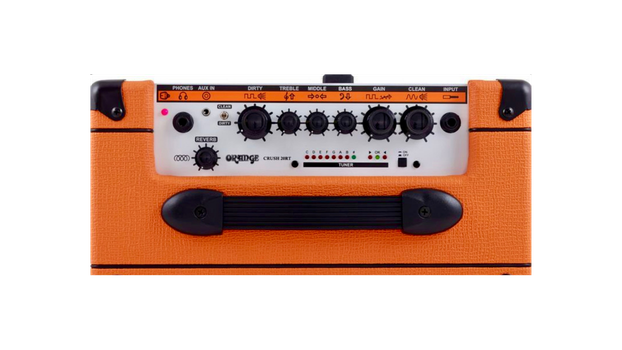
Controls are dead simple: gain, EQ, reverb, channel select, all laid out in a way that doesn’t require a manual.
That’s a real plus for a beginner still building muscle memory, and it’s just as welcome for a comeback player who doesn’t want to relearn a menu system after a 15-year break.
Hardware
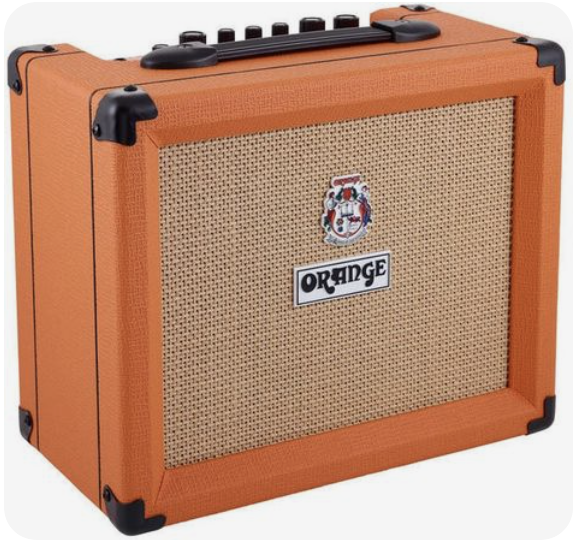
The custom 8″ “Voice of the World” speaker is doing a lot of the heavy lifting here, and it punches well above what you’d expect from an amp this size.
Build quality feels solid rather than flimsy. Orange didn’t phone in the cabinet construction just because this sits at the bottom of their lineup.
Connectivity covers the bases: 1/4″ instrument input, 1/8″ aux in for backing tracks, 1/4″ headphone/CabSim out, and a 1/4″ footswitch jack for channel switching on the fly.
The two real hardware limitations:
- There’s no effects loop, so time-based pedals go in front of the amp only
- The single shared 3-band EQ means you can’t dial in drastically different tone shapes between your clean and dirty channels independently.
Sound Test
Clean
Warm, a little vintage-voiced, with a natural breakup as you push the volume. Great for blues rhythm and lower-gain rock tones; not the amp for glassy, ultra-headroom cleans.
Crunch
This is the sweet spot. Classic rock crunch with real bite and clarity. Power chords stay defined instead of collapsing into mush, even with the gain up past noon.
If crunch tone is your main concern, it’s worth seeing how this stacks up in our Boss Katana 50 vs. Fender Mustang LT50 comparison, since gain response is where these budget practice amps tend to separate themselves.
High Gain
Impressively usable for a $229 amp. It won’t replace a dedicated metal head, but for practicing riffs in the Sabbath-to-Metallica range, it holds its own and stays articulate.
| Pros | Cons |
|---|---|
|
✅ Analog Feel — fully analog signal path gives it dynamic, tube-like responsiveness ✅ Great Overdrive — classic rock crunch and high-gain distortion with real note clarity ✅ Excellent Headphone Output — CabSim emulates an Orange 4×12″ cab for silent practice or direct recording ✅ Feature Packed — built-in reverb and tuner are huge conveniences at this price |
⚠️ No Effects Loop — time-based pedals can’t sit after the preamp ⚠️ Limited Clean Headroom — the Clean channel breaks up sooner than players wanting pristine cleans might like ⚠️ No Built-in Modulation — only reverb onboard; delay, chorus, and phaser need separate pedals ⚠️ Shared EQ — one 3-band EQ serves both channels, limiting independent tone shaping |
How We Tested: The String Shock Methodology
Every String Shock review runs through the same four-pillar stress test; no exceptions, no shortcuts. Here’s how the Crush 20RT held up.
1. Tone Across Pickup Types
I ran the amp through both channels with a handful of guitars from my own collection. This included my Epiphone SG and my Squier Strat.
I wanted to get a real read on how it handles humbuckers versus single coils.
2. Channel Behavior Under Pressure
I tested the Clean channel at varying volumes to find exactly where natural breakup kicks in, then pushed the Dirty channel from light crunch all the way to full gain to hear whether it holds note clarity or collapses into mush once you dig in.
3. Real-World Usability
I ran the CabSim headphone output through both headphones and directly into a recording interface to judge how usable it actually is for silent practice and home recording. Not just whether it technically works, but whether you’d actually want to use it.
4. Accuracy and Reliability
I A/B’d the built-in tuner against a standalone clip-on to confirm it’s actually accurate enough to trust, not just a novelty feature bolted on for the spec sheet.
⚡️Read more gear reviews at the String Shock Gear Zone.
Spec Recap
| Specification | Detail |
|---|---|
| Output Power | 20 Watts |
| Speaker | 1 x 8″ Voice of the World |
| Channels | 2 (Clean and Dirty) |
| EQ | 3-Band (Bass, Middle, Treble), shared between channels |
| Effects | Digital Spring Reverb |
| Tuner | Built-in chromatic tuner |
| Connectivity | 1/4″ Instrument Input, 1/8″ Aux In, 1/4″ Headphone/CabSim Out, 1/4″ Footswitch Jack |
| Weight & Dimensions | 15.9 lbs (7.2 kg) | 14.76″ x 12.8″ x 7.8″ |
| Price | $229 |
Final Verdict
Cheap and budget are NOT the same word, and the Orange Crush 20RT is the amp that proves it.
For $229 you’re getting real Orange tone, a fully analog signal path, a built-in tuner and reverb, and a headphone output good enough to actually record through.
It’s not a gigging amp for a loud rock room, and the shared EQ and missing effects loop are real limitations if you’re chasing pedal-heavy tones.
But as a first amp, a comeback amp, or a dedicated practice rig, it’s one of the smartest budget buys on the market right now, and proof that the brand behind the amp still matters, even at the bottom of the price range.
| Retailer | Price | Link |
|---|---|---|
| Amazon | $229 | Check Price on Amazon |
| Reverb | $139 (used) | Check Price on Reverb |

Build Your Total Rock Rig
⚡️FREE: The 15-Minute Rock Guitar Practice Routine
Stop “practicing” and start playing. Grab the daily blueprint I use to keep my fingers stage-ready in just 15 minutes.
Frequently Asked Questions
1. Is the Orange Crush 20RT good for beginners?
Yes. It’s one of the more beginner-friendly amps in its price range because it includes a built-in tuner and reverb, so you’re not scrambling for extra gear before you even plug in.
2. Is the Orange Crush 20RT loud enough to gig?
At 20 watts, it can handle small rooms and low-volume gigs, but it’s not built to compete with a full band at stage volume without mic support.
3. Does the Orange Crush 20RT have an aux input or headphone jack?
Yes to both. It has a 1/8″ aux input for playing along with backing tracks, plus a 1/4″ headphone/CabSim output for silent practice or direct recording.
4. Can you use pedals with the Orange Crush 20RT?
Yes, pedals work fine in front of the amp. The one limitation is that there’s no effects loop, so time-based pedals like delay and modulation sit before the preamp rather than after it.
$